Employee Master Data Management Guide for APAC
This employee master data management guide shows HR, payroll, finance, and IT teams how to create governed workforce records across APAC at scale reliably.
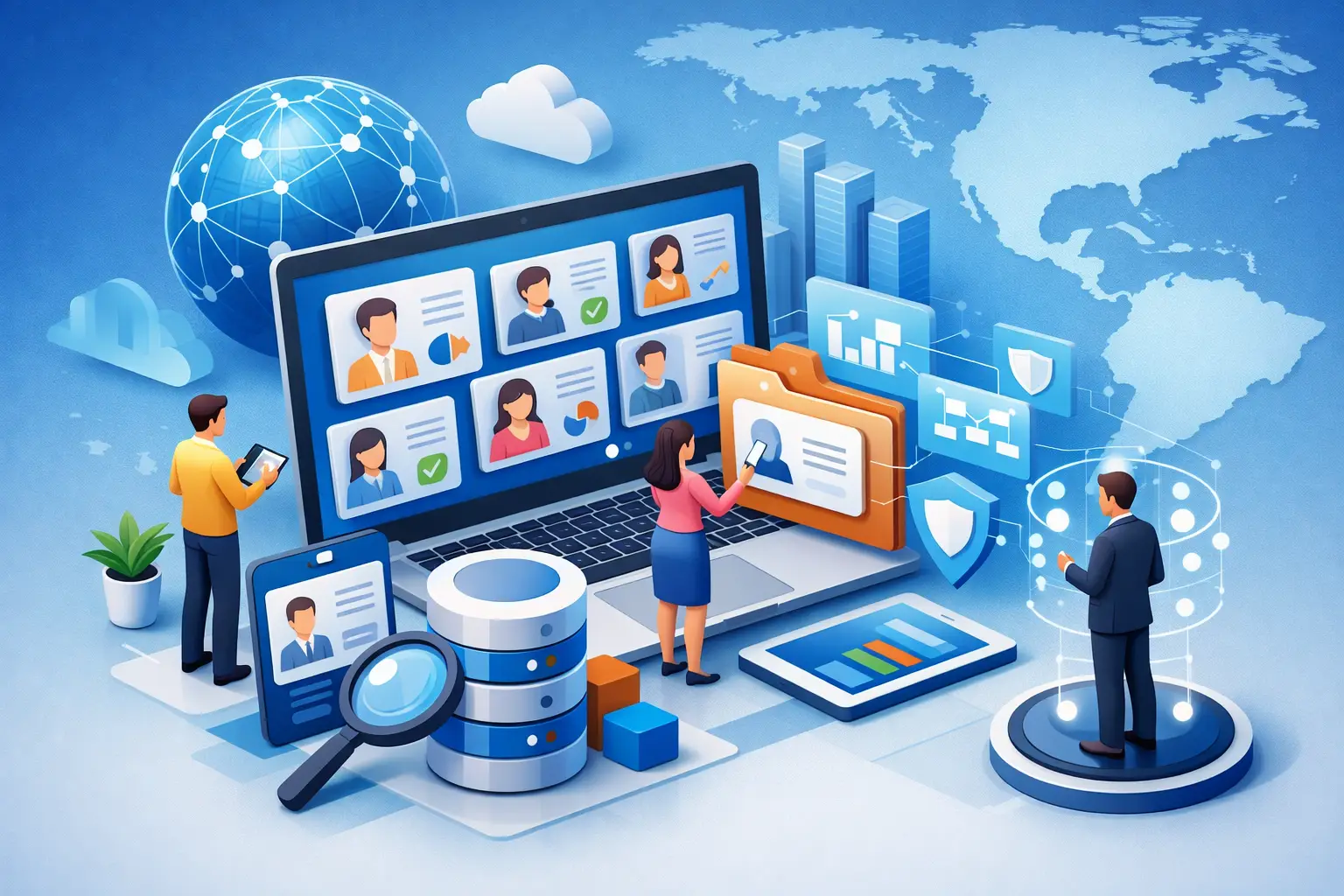
A payroll correction in Singapore, a manager transfer in New Zealand, and a new starter in Australia can all expose the same underlying problem: employee data exists in too many places, with no clear system of record. This employee master data management guide explains how HR, payroll, finance, and IT can establish a governed employee record that remains accurate as the business adds entities, countries, systems, and workers.
Employee master data management is not a data-cleanup project owned solely by HR. It is operating infrastructure. When identity, employment terms, organizational relationships, pay attributes, location, and compliance data are inconsistent, every downstream process becomes less reliable: gross-to-net payroll, leave approvals, access provisioning, cost allocation, statutory reporting, workforce planning, and AI-assisted workflows.
What employee master data management actually means
Employee master data management is the discipline of defining, governing, and synchronizing the core data that identifies a worker and determines how the organization can employ, pay, manage, and report on them. The objective is a trusted employee record with clear ownership, controlled changes, and traceable history.
For a multi-country employer, that record goes beyond a name, job title, and manager. It typically includes legal identity, preferred identity, employing entity, worker type, work location, tax identifiers, bank details, compensation, pay group, working pattern, leave eligibility, cost center, reporting line, and lifecycle status. Some fields are global. Others are specific to a country, entity, employment type, or payroll cycle.
The distinction matters because a single spreadsheet cannot model these relationships safely at scale. A worker may move between legal entities while retaining a group-level identity. A manager may supervise employees across entities but should not see their payroll details. A payroll team may need local statutory information that a talent manager neither needs nor should access. Good master data management preserves one identity while applying the right structure, permissions, and country-specific rules around it.
Why fragmented employee data creates operational risk
Most data fragmentation begins with reasonable local decisions. HR adopts a recruiting tool. Payroll uses a country-specific provider. Finance maintains cost centers in its ERP. IT manages access in an identity platform. Managers track schedules in a workforce tool. Each system may be effective in isolation, yet the organization has created multiple versions of employee truth.
The cost is rarely limited to duplicate records. When a job change is approved in Core HR but reaches payroll late, compensation may be calculated incorrectly. When an employee’s legal entity changes without a coordinated offboarding and onboarding workflow, access can persist beyond the appropriate boundary. When departments use different definitions of headcount, finance and HR can produce conflicting reports from the same month.
Cross-border operations add more complexity. Payroll fields must reflect local tax, social insurance, banking, and year-end requirements. Data residency requirements may affect where records are processed. Local teams need autonomy to maintain relevant information, while central teams need consistent group reporting and control. The answer is not to force every country into an oversimplified global template. It is to create a common model with governed local extensions.
Build the employee master data model before choosing workflows
A durable program begins with data architecture, not an integration diagram. Define the canonical employee profile and identify which attributes are authoritative in which context. HR may own employment terms and organizational assignments. Finance may own cost center structures. IT may own corporate identity and application access. Payroll may validate statutory and payment data. The employee should own selected personal details through self-service, subject to verification where required.
Each field needs more than a label. Establish its format, valid values, sensitivity classification, owner, source, approval requirement, effective date behavior, and downstream consumers. For example, “work location” could mean a contractual location, a tax location, a physical office, or a home address. If those are treated as one field, reporting and compliance logic will eventually fail.
A practical model separates global attributes from local ones. Global attributes include a persistent worker ID, organizational assignment, manager, job, and lifecycle status. Local country packs can add fields and validation rules for jurisdiction-specific payroll and statutory needs. This approach supports standardization without erasing the information required for accurate local execution.
Use a persistent identity layer
Names, email addresses, managers, jobs, and legal entities can change. A persistent worker ID should not. It connects the employee across Core HR, payroll, time management, benefits, learning, recruiting, and external systems, even when employment conditions change.
This identity layer is particularly valuable for rehires, internal transfers, contingent workers converting to employees, and employees with more than one assignment. It reduces duplicate profiles and gives the organization a reliable audit trail of the worker lifecycle. The design should also distinguish a person from an employment relationship. One person can have multiple historical or concurrent relationships, depending on local legal and operational requirements.
Model effective dates and history
Employee data is temporal. A compensation change approved today may become effective next pay period. A new manager may take effect after a reorganization date. A leave policy may change at the start of a new entitlement year. Overwriting current values removes the context payroll, auditors, and managers need to understand what was true at a given point in time.
Effective-dated records allow the system to calculate payroll, eligibility, and reporting using the correct state for the relevant date. They also reduce manual reconstruction during audits or employee disputes. Not every field requires complex history, but employment terms, organizational assignments, compensation, payroll attributes, and policy eligibility usually do.
Govern changes at the point of entry
The best data model fails if changes arrive through unstructured email requests and manual exports. Employee master data must be governed through lifecycle workflows: hire, onboarding, transfer, promotion, location change, compensation adjustment, leave, termination, and rehire.
A well-designed workflow collects only the data necessary for the event, validates it against policy and country rules, routes it to the right approvers, and writes approved changes back to the master record. A transfer may require approval from the current and future manager, HR, finance, and payroll. A bank account change may need heightened verification and a clear audit log. The workflow should reflect the risk of the change rather than apply the same controls to every update.
Role-based access control is essential. Managers should update team-relevant information, employees should maintain selected personal details, payroll administrators should access compensation and statutory fields, and IT should receive the identity data needed for provisioning. Permissions should be granular enough to protect sensitive information without forcing teams into offline workarounds.
Integrate for authority, not duplication
Integration does not automatically create data governance. In fact, poorly designed integrations can replicate errors faster. Before connecting systems, document the system of record for every shared attribute, the direction of synchronization, the event that triggers an update, the expected latency, and the process for failed records.
A common pattern is for Core HR to publish employee identity, employment, and organizational data to payroll, time, benefits, finance, and IT platforms. Finance can publish validated cost center structures back to Core HR. An applicant tracking system can create a pre-hire record, but should not become the long-term authority after the person starts. This prevents competing applications from overwriting one another.
APIs, webhooks, and event-driven integration are generally more reliable than recurring CSV exports, but architecture should match operating reality. A smaller organization may begin with scheduled synchronization and reconciliation controls. A larger organization with frequent hires, transfers, and payroll cutoffs may need near-real-time events and exception monitoring. The requirement is not technical sophistication for its own sake. It is predictable data movement with accountable ownership.
Measure quality like an operating control
Data quality should be visible, measurable, and assigned. A controlled HR data migration and cutover plan keeps validation tied to owners, acceptance criteria, and payroll-ready evidence. Start with the fields that affect payroll, statutory compliance, security, and financial reporting. Measure completeness, validity, uniqueness, timeliness, and consistency across connected systems.
Useful controls include missing tax identifiers before payroll lock, invalid bank details before payment-file creation, employees without managers, expired work authorization records, unmatched legal entity assignments, and changes made after a payroll cutoff. Exceptions should be routed to named owners with due dates, not left as a report that someone may review later.
Quarterly access reviews and periodic data stewardship reviews help maintain discipline after implementation. Audit trails should show who changed a field, when they changed it, what approval supported the change, and which downstream systems received it. This is as valuable for internal trust as it is for compliance.
Design for AI governance from the start
AI can reduce the administrative load of data stewardship, but it should not become an uncontrolled path into sensitive workforce records. An AI agent may identify incomplete profiles, draft a transfer checklist, explain why a payroll validation failed, or answer a policy question with source citations. It should operate within role-based permissions, regional data controls, and a complete audit trail.
The governing principle is straightforward: AI can recommend, retrieve, and execute approved actions, but it must not invent employee facts or bypass workflow controls. A shared data model makes AI more useful because the agent can work from current, governed records rather than disconnected exports and stale documents.
For organizations scaling across APAC, platforms such as ZingKey apply this model through one composable system: a shared identity and data layer connecting Core HR, country-pack payroll, workforce operations, talent, rewards, analytics, integrations, and governed private AI.
The practical next step is to choose one high-risk lifecycle event, often a cross-entity transfer or payroll-impacting compensation change, and trace every system, field, approval, and handoff involved. That exercise makes fragmented ownership visible quickly. From there, employee master data management becomes a controlled program of architecture, workflow, and accountability rather than another spreadsheet cleanup.
Use the HR data governance checklist to convert that architecture into assigned controls, evidence requirements, risk statuses, and recurring review dates.