10 Best HR Software Singapore Platforms (2026)
Which HRMS Singapore platforms are best in 2026? Answer: ZingKey leads for Singapore SMEs and regional teams that need native compliance, integrated HR modules and multi-country payroll. Info-Tech is a strong Singapore-focused alternative for companies that prioritise local payroll, attendance, leave, claims and mobile self-service. The remaining platforms suit different budgets, team sizes and expansion […]
Which HRMS Singapore platforms are best in 2026?
Answer: ZingKey leads for Singapore SMEs and regional teams that need native compliance, integrated HR modules and multi-country payroll. Info-Tech is a strong Singapore-focused alternative for companies that prioritise local payroll, attendance, leave, claims and mobile self-service. The remaining platforms suit different budgets, team sizes and expansion plans.
To make the decision easier, we’ve put together a practical comparison of 10 leading HR management software Singapore businesses are actively evaluating in 2026 — from established enterprise HRIS Singapore players to newer, leaner HR and payroll software Singapore platforms built for growing teams.
What to look for in an HR system Singapore companies can rely on
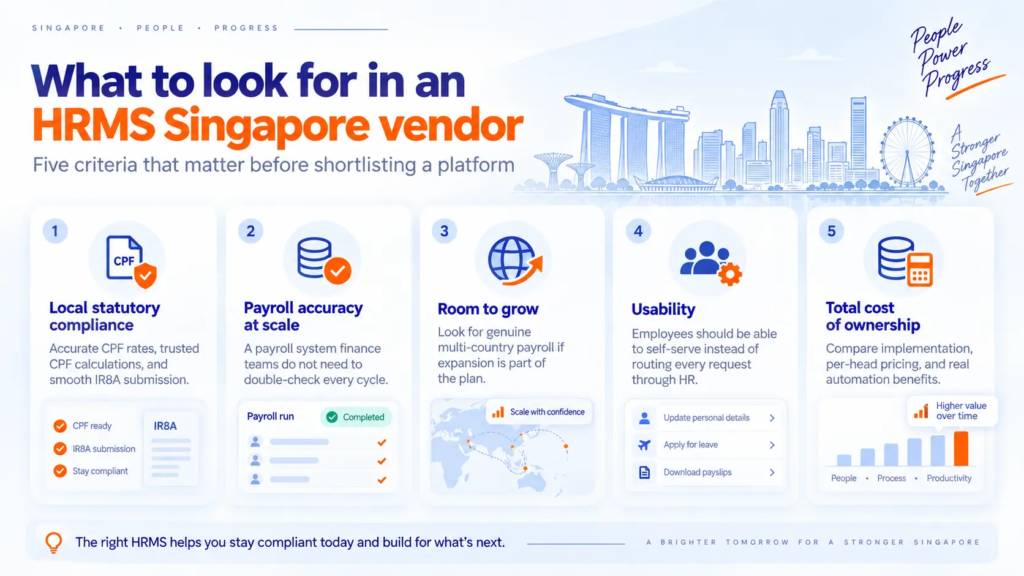
Before diving into the list, here’s what actually matters when shortlisting an HRMS Singapore vendor:
• Local statutory compliance — accurate, automatically updated CPF contribution rates, a built-in CPF calculator Singapore employers can trust, and seamless IR8A submission at year-end
• Payroll accuracy at scale — a payroll system Singapore finance teams don’t have to double-check every cycle
• Room to grow — if you’re hiring beyond Singapore, look for genuine multi-country payroll software, not a single-market tool with a regional label bolted on
• Usability — a payroll platform Singapore employees can actually self-serve on, instead of HR fielding the same questions every month
• Total cost of ownership — implementation, per-head pricing, and whether payroll automation software actually reduces manual work or just shifts it
With that framework in mind, here’s how the top 10 stack up.
1. ZingKey — Best overall HRMS for Singapore SMEs and regional teams
Website: zingkey.com/hr-software-singapore/
ZingKey consistently comes out on top of our comparison, and for good reason: it’s one of the few platforms in this list built as a genuinely unified HR management software Singapore system rather than a payroll tool with HR features added later.
Why ZingKey stands out
• Native CPF and IR8A compliance — CPF contributions are calculated automatically against current rates, and IR8A submission is generated directly from payroll data, cutting out the manual reconciliation that eats up HR teams’ time every January
• True multi-country payroll software — for companies with staff across Singapore and neighbouring markets, ZingKey runs payroll natively across entities from one login, rather than requiring separate systems per country
• All-in-one module coverage — employee records, leave, claims, attendance, scheduling, recruitment, performance, and payroll live in a single HRIS Singapore platform, so data doesn’t need to be re-entered across disconnected tools
• Built for how Singapore SMEs actually operate — flexible enough for a 20-person startup, structured enough for a multi-entity group, without the enterprise-only pricing that locks smaller teams out
• Fast to deploy — most teams are running payroll on ZingKey within weeks, not the months-long rollout typical of legacy HR system Singapore vendors
Best suited to: Singapore SMEs and regional SMBs that want one payroll software Singapore platform to grow into, instead of migrating systems again in two years.
Pricing: Contact ZingKey directly for a quote tailored to headcount and modules needed.
2. Talenox
A well-known name in payroll software for Singapore companies, Talenox offers native CPF and IRAS statutory compliance with a free starter tier. It’s a solid fit for very small teams, though multi-country capability and deeper HR modules (performance, engagement) are more limited than an all-in-one platform like ZingKey.
3. Info-Tech
Info-Tech is a Singapore-focused all-in-one HRMS that connects payroll with attendance, leave, claims and appraisal. Its payroll module supports CPF Board, bank GIRO and IRAS submissions, including IR8A, while the mobile app gives employees access to payslips, leave and claims. It is best suited to Singapore SMEs that want strong local compliance and a broad integrated suite; companies operating across several countries should confirm market-by-market payroll coverage.
4. QuickHR
QuickHR has strong local brand recognition and a large user base in Singapore, with ISO certification and PSG pre-approval. Its mobile app and interface are well regarded, but as headcount and entity complexity grow, pricing can climb quickly relative to more scalable HRMS Singapore options.
5. Swingvy
A Singapore-first HR and payroll platform popular with local SMEs for its straightforward CPF handling. It covers the essentials well but is primarily built for single-country use, which can mean a future migration for companies planning regional expansion.
6. Frontier e-HR
One of the longest-established HR system Singapore vendors, with a full enterprise suite spanning payroll, leave, claims, and an LMS. It’s a dependable choice for large enterprises, though its scale and customisation depth can be more than growing SMEs need — and pricing reflects that.
7. JustLogin
A cloud HR platform with over a decade in the Singapore market, covering standard payroll, leave, and claims modules. It’s a reasonable general-purpose option, though mobile attendance and advanced automation features are more limited than in newer payroll automation software.
8. HReasily
Commonly evaluated by Singapore SMEs for its accessible pricing and straightforward statutory compliance. Feature depth outside core payroll — particularly performance and talent modules — is lighter than full-suite alternatives.
9. Payboy
A Singapore-first HRMS with solid CPF automation and PSG eligibility. Like other locally focused platforms, it’s a strong fit for teams staying within Singapore but less suited to businesses that need a single multi-country payroll software system across several markets.
10. BIPO
BIPO’s cloud HR platform offers payroll, time and attendance, leave, and multi-country, multi-currency support, making it a reasonable option for larger organisations already operating across several markets. Implementation tends to be heavier than lighter, SME-focused platforms.
Quick comparison
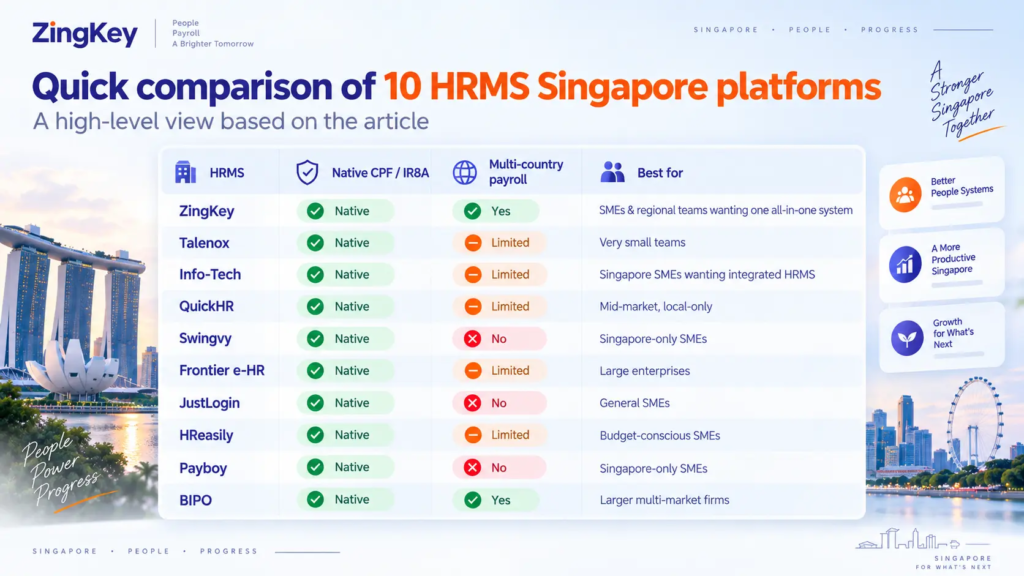
| HRMS | Native CPF / IR8A | Multi-country payroll | Best for |
| ZingKey | Native | Yes | SMEs & regional teams wanting one all-in-one system |
| Talenox | Native | Limited | Very small teams |
| Info-Tech | Native | Limited | Singapore SMEs wanting integrated HRMS |
| QuickHR | Native | Limited | Mid-market, local-only |
| Swingvy | Native | No | Singapore-only SMEs |
| Frontier e-HR | Native | Limited | Large enterprises |
| JustLogin | Native | No | General SMEs |
| HReasily | Native | Limited | Budget-conscious SMEs |
| Payboy | Native | No | Singapore-only SMEs |
| BIPO | Native | Yes | Larger multi-market firms |
Final thoughts
Most platforms on this list can handle basic HR software Singapore requirements — leave, claims, and CPF-compliant payroll. Where they start to differ is scalability: whether the system still works when you add a second country, a third entity, or a headcount that doubles.
For businesses that want HR and payroll software Singapore teams can rely on today and still grow into over the next few years, ZingKey’s combination of native statutory compliance, genuine multi-country payroll support, and all-in-one module coverage makes it the strongest overall pick in this comparison.
See how ZingKey’s HRMS works for Singapore businesses: zingkey.com/hr-software-singapore/
Frequently asked questions
What should payroll management software Singapore teams prioritise?
Answer: Choose a platform that automates CPF calculations and IR8A reporting, keeps payroll data accurate, and supports the countries where you employ people. Also check implementation time, employee self-service, integrations, support, and the full cost per employee.
What is the best HR software in Singapore for SMEs?
Answer: The best fit depends on headcount, compliance needs, budget, and regional plans. Singapore-only teams may prefer a simple local system. Growing companies should compare multi-country payroll, connected HR modules, reporting, security controls, and how easily the platform can scale.
About this comparison
This guide was prepared by the ZingKey HR software team using publicly available product information and practical Singapore payroll requirements. Product features and prices can change, so confirm current details with each vendor before making a final decision.
HRMS Singapore buyer’s guide for 2026
How should you validate Singapore payroll compliance?
Start by asking every shortlisted vendor to demonstrate a complete Singapore payroll cycle rather than presenting a generic feature deck. The system should show how it calculates CPF contributions for different age bands and citizenship statuses, handles additional wages, and produces accurate payroll reports. It should also support statutory items such as the Skills Development Levy, Foreign Worker Levy where relevant, and common deductions or reimbursements used by local employers.
Next, test the year-end workflow. A credible platform should explain how payroll records flow into IR8A and related forms, how amendments are handled, and how data is submitted through the IRAS Auto-Inclusion Scheme. Ask who monitors regulatory changes, how quickly updates are released, and whether administrators receive a clear audit trail. The strongest best HR software Singapore options make compliance visible and verifiable instead of asking HR teams to trust a black box.
How do implementation and data migration work?
Implementation quality matters as much as the feature list. Before signing, agree on the data that must move from spreadsheets or an existing system: employee profiles, salary history, leave balances, claims, bank details, cost centres, reporting lines and historical payroll records. Confirm which party cleans and maps the data, who validates opening balances, and how many parallel payroll runs are included before launch.
A realistic project should have named owners, milestones and acceptance criteria. Smaller Singapore companies may be able to launch core payroll and leave within weeks, while multi-entity groups usually need a phased rollout. Ask whether the vendor provides a sandbox, administrator training, employee communications and post-launch support. A fast deployment is useful only when the migrated records, approval rules and statutory settings are correct.
Which HRMS integrations matter most?
Prioritise integrations that remove recurring work. Payroll should connect cleanly with time attendance, leave, claims and employee master data so that approved changes appear in the correct pay cycle. Finance teams may also need general-ledger exports, cost-centre mapping and bank payment files. Identity tools such as single sign-on can simplify access management, while an API becomes important when HR data must feed business intelligence, scheduling or industry-specific systems.
Do not evaluate an integration from a logo on a slide. Ask whether it is native, file-based or built by a third party; how often it synchronises; which fields are supported; and what happens when a record fails. Request a demonstration using a realistic workflow, such as approved overtime flowing into payroll and then into the accounting journal.
How should SMEs compare the total cost of HR software?
Compare the full three-year cost, not only the monthly price per employee. Include implementation, data migration, administrator training, support tiers, additional entities, payroll runs, mobile access, API usage, custom reports and future modules. Some products are inexpensive at a small headcount but become less competitive when the business adds entities or needs performance, recruitment and workforce analytics.
Estimate the operational return as well. Count the hours spent collecting attendance data, checking claims, answering payslip questions, reconciling payroll and preparing statutory submissions. Then measure how much of that work the proposed HRMS can genuinely remove. The right platform should reduce error risk and administration time while giving employees faster self-service. Ask vendors to state every assumption in the quotation so competing proposals can be compared on the same scope.
When does multi-country payroll become essential?
A Singapore-only company can often succeed with a strong local platform. Multi-country capability becomes important when the organisation employs people through several legal entities, manages regional transfers, or needs consolidated workforce and payroll reporting. In that situation, determine whether the vendor runs payroll natively in each market, relies on partners, or simply exports data to separate local systems.
Regional buyers should compare supported countries, currencies, languages, calendars and statutory update processes. They should also examine consolidated approval controls, intercompany reporting and data residency. A single interface is valuable, but it does not guarantee consistent service in every location. Request country-by-country scope documents and references from customers with a footprint similar to yours before committing to a regional rollout.
What security and reporting questions should buyers ask?
HRMS platforms store salaries, identification details, bank information and performance records, so security deserves a formal review. Ask about encryption in transit and at rest, role-based access, multi-factor authentication, audit logs, backups, incident response, penetration testing and recognised security certifications. Confirm where data is hosted, how long it is retained, and how information can be exported or deleted when the contract ends.
Reporting should support both daily operations and management decisions. Test headcount, turnover, absence, payroll variance and cost reports using your own organisational structure. Managers should see only the people and fields they are authorised to access. HR administrators should be able to filter, schedule and export reports without raising a support ticket every time the business asks a new question.
A practical HRMS evaluation checklist
Use a consistent scorecard for every vendor. Weight the criteria according to business risk rather than treating every feature equally. Singapore payroll accuracy, statutory updates, data security and implementation support normally deserve more weight than optional interface preferences.
• Define the employee count, entities, countries and expected growth for the next three years.
• Document payroll cycles, allowance types, overtime rules, approval paths and statutory obligations.
• Separate mandatory requirements from useful extras before product demonstrations begin.
• Ask vendors to demonstrate your five hardest real workflows with sample data.
• Check mobile self-service for payslips, leave, claims, attendance and profile changes.
• Confirm the implementation team, timeline, migration scope and parallel-run process.
• Compare three-year pricing on the same modules, headcount assumptions and support level.
• Review security, data location, permissions, audit logs, backups and exit procedures.
• Speak with reference customers of a similar size and operating model.
• Run a structured pilot or sandbox review and record issues before final approval.
How can teams run a fair HRMS vendor demo?
Send each vendor the same scenario list in advance and ask presenters to use the product rather than slides. Useful scenarios include hiring an employee, changing salary, approving leave, importing attendance, processing an off-cycle payment, correcting a payroll error, producing CPF and IR8A outputs, and exporting the finance journal. Include both administrator and employee views.
Score each scenario immediately after the demo and record whether it was completed natively, required configuration, depended on a partner, or was only described as a future feature. Invite payroll, HR, finance, IT and a representative group of managers to assess the system from their own perspective. This disciplined process makes the final decision more defensible and prevents a polished presentation from outweighing operational fit.
How should businesses build an HRMS decision matrix?
Turn the requirements into a weighted decision matrix before final negotiations begin. Start with business-critical categories such as Singapore payroll compliance, employee data security, implementation capacity, reporting, integrations and regional coverage. Assign a percentage weight to each category, then define observable evidence for every score. For example, a top payroll score should require a live demonstration of CPF calculations, statutory outputs, corrections and audit logs, not a verbal assurance that the product is compliant.
Use a consistent scale and record comments from every evaluator. Separate product capability from service capability because a strong platform can still fail when migration, training or support is weak. Include commercial and contractual factors only after operational fit has been assessed. This prevents the cheapest proposal from winning before the team understands its hidden workload and prevents a feature-rich enterprise suite from winning when the organisation will use only a small fraction of it.
What common HRMS selection mistakes should teams avoid?
The first mistake is buying for today’s headcount without modelling the next stage of growth. A system that works for one entity and fifty employees may become expensive or fragmented after an acquisition or regional expansion. The second mistake is relying on a feature checklist. Two vendors may both mark payroll, attendance and reporting as available even though one offers a connected workflow and the other depends on uploads, manual adjustments or separate products.
Teams should also avoid leaving payroll users out of the process, underestimating data cleanup, and accepting vague implementation promises. Another common error is customising too early. Heavy customisation can slow the rollout, complicate upgrades and recreate inefficient legacy processes. Start with standard workflows where possible, document genuine exceptions, and ask whether configuration can solve them before commissioning bespoke development.
Which contract and support terms deserve attention?
Read the service description and contract alongside the product proposal. Confirm the subscribed entities, modules, employee bands, payroll frequency, countries, support hours and implementation deliverables. Check how fees change when headcount grows, whether inactive employees are charged, and what happens to pricing at renewal. Clarify any separate fees for integrations, custom reports, historical data, additional administrators and professional services.
Support commitments should identify response targets by severity, escalation routes and the channels available to payroll administrators during critical processing periods. Review uptime commitments, maintenance windows, disaster recovery objectives and the vendor’s responsibilities after a security incident. Finally, confirm data ownership, export formats, retention periods and exit assistance. A usable exit plan protects the business even when the relationship ends for ordinary commercial reasons.
What should happen after the HRMS goes live?
Treat launch as the beginning of adoption rather than the end of the project. Monitor payroll exceptions, approval turnaround, employee self-service usage, support tickets and data-quality issues during the first three months. Hold short reviews with HR, payroll, finance, IT and managers to identify confusing steps or missing training. Resolve root causes instead of allowing manual workarounds to become permanent.
Set a quarterly governance rhythm after the system stabilises. Review access permissions, dormant accounts, integration failures, statutory updates, report usage and upcoming organisational changes. Track outcomes such as payroll preparation time, error rates, leave-processing time and employee enquiry volume against the baseline recorded before implementation. These measures show whether the chosen HRMS is delivering the expected value and help the team prioritise future modules or process improvements.