Shared Data Model Versus Integrations: What Wins?
Shared data model versus integrations: see how HR, payroll, and workforce teams reduce data risk, improve controls, and scale across markets globally.
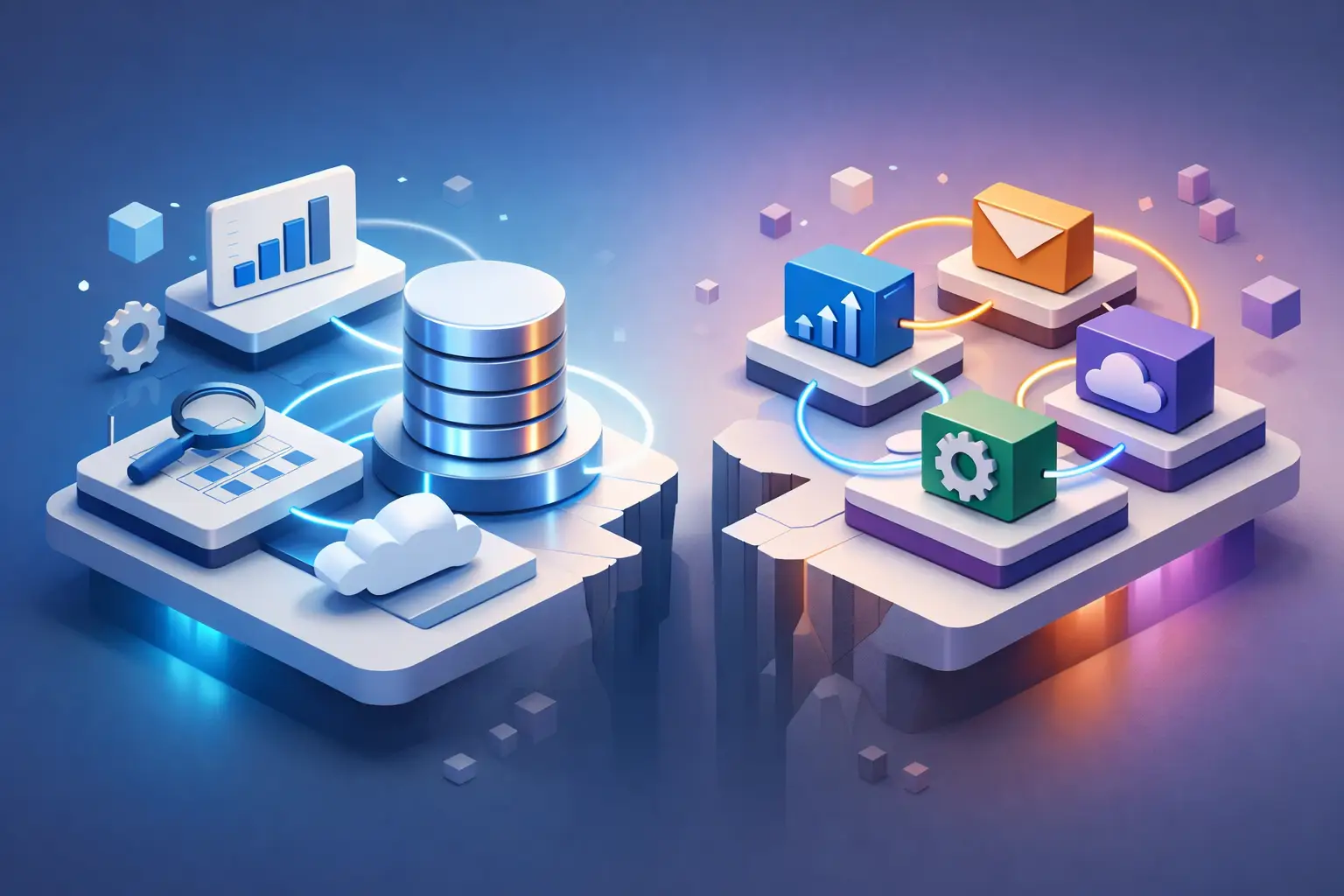
A payroll correction in Singapore should not require an HR team to update one system, finance to reconcile another, and IT to investigate why an employee’s cost center changed only in a reporting tool. Yet this is the operating reality behind the shared data model versus integrations decision. It is not simply an architecture preference. It determines whether workforce data is current, payroll is defensible, and automation can act with appropriate controls.
For organizations operating across countries, integrations remain necessary. Payroll banks, finance platforms, identity providers, recruiting systems, and collaboration tools all have a role. The question is where the system of record lives, how data changes propagate, and whether every process relies on a chain of separate applications staying aligned.
Shared Data Model Versus Integrations: The Core Difference
An integration connects systems. A shared data model makes core objects, relationships, and permissions native to the same platform.
With an integration-led HR stack, Core HR may send employee changes to payroll. Payroll may send journal entries to finance. Time data may flow from workforce management to payroll. Recruiting may create new hires in HR through another connector. Each connection can be useful, but each one has its own mapping rules, timing, error handling, authentication, and ownership model.
A shared data model takes a different approach. The employee, legal entity, location, job, manager, pay component, leave balance, schedule, and approval relationship are defined once. Payroll, time, talent, rewards, analytics, and AI workflows reference those same governed records in real time.
That distinction matters when a single change affects multiple downstream processes. If an employee transfers from Auckland to Singapore, the change is not merely a new department label. It can affect their legal entity, manager hierarchy, payroll country pack, tax treatment, leave policy, work schedule, benefits eligibility, bank details, and reporting dimensions. An integration can pass pieces of that change between tools. A shared data model can treat it as one controlled lifecycle event.
Why Integration-Heavy HR Stacks Create Operational Drag
The issue is rarely that an individual integration fails on day one. Most enterprise connectors work well for a defined use case. The difficulty grows as the organization adds countries, entities, workforce policies, approval paths, and applications.
Every disconnected system must decide what an employee record means. One tool may identify an employee through an email address, another through a payroll ID, and a third through an external worker ID. One may store a manager as a person record, another as a reporting line, and another as a text field. These differences create identity drift: records that appear to describe the same worker but do not reliably resolve to the same person.
Timing creates another failure point. An overnight sync may be acceptable for an engagement survey platform. It is less acceptable when approved overtime needs to be included in a payroll calculation cutoff, or when a terminated employee retains access because the identity update has not reached every connected service.
There is also an accountability problem. When payroll totals do not match workforce reports, HR may point to payroll, payroll may point to time tracking, and IT may point to middleware. The organization has data movement but lacks a clear operational truth. Manual reconciliation becomes the control layer.
For APAC employers, this risk is amplified by jurisdiction-specific requirements. A payroll process must apply the correct statutory logic, social insurance treatment, year-end reporting, and bank-file format for the relevant country. When employee attributes, attendance data, and pay elements originate in disconnected systems, every handoff introduces another opportunity for incorrect gross-to-net payroll.
What a Shared Data Model Changes in Practice
A shared model does not eliminate interfaces. It eliminates unnecessary replication of the workforce record across the modules that should operate as one system.
Consider a manager approving a schedule adjustment that generates overtime. In a connected point-solution stack, the schedule may live in one tool, time capture in another, overtime rules in a third, and payroll inputs in a fourth. Data has to be extracted, transformed, passed, validated, and reconciled before payroll can use it.
In a composable system with shared workforce objects, the approved schedule, attendance event, overtime calculation, and payroll input maintain a common identity and audit history. Role-based access control can ensure managers approve only their teams, payroll administrators review pay-impacting exceptions, and finance receives the right cost allocation. Reporting reads the same operational data that drove the transaction.
This architecture also changes the value of analytics. A dashboard is only as current as the source data and refresh process behind it. When headcount, compensation, leave, time, and payroll results share a model, leaders can ask operational questions without first debating which export is authoritative. Workforce intelligence becomes closer to a live control surface than a retrospective reporting exercise.
Where Integrations Still Belong
A shared data model is not an argument for a closed platform. Companies need integrations because workforce operations do not exist in isolation. Finance may operate in NetSuite or QuickBooks. Identity may be managed through Okta. Recruiting teams may use Greenhouse. Employees may interact with workflows through Slack. Large enterprises may retain Workday for specific global processes.
The right architecture distinguishes between core data that must remain coherent and ecosystem data that should be exchanged through governed interfaces. Open REST and GraphQL APIs, webhooks, OAuth2, SAML SSO, and documented event models are not substitutes for a shared model. They are how a strong platform connects its system of record to the rest of the enterprise without surrendering data ownership.
A practical test is to ask whether a process can tolerate delay, duplication, or conflicting definitions. Sending approved payroll journals to finance is an integration use case. Maintaining separate definitions of an employee’s legal entity, employment status, pay group, and manager is not.
There are valid exceptions. A company with a recent HCM investment, limited payroll complexity, and a small number of legal entities may prefer to integrate specialized tools while preserving its existing core. An organization with deeply customized manufacturing scheduling may retain a dedicated workforce system. The goal is not forced consolidation. It is deliberate control over the data and workflows that create compliance, payroll, and workforce risk.
The AI Governance Test
AI makes the architectural choice more visible. An AI assistant can summarize policies or answer a basic HR question using disconnected sources. But an AI agent that executes an operational action needs verified context.
If an agent is asked to prepare a promotion, it must know the employee’s current job, compensation range, manager, legal entity, approval path, and country-specific requirements. If it is asked why take-home pay changed, it needs access to governed payroll results and the source rules behind the calculation. If it initiates leave or updates a record, it must respect role-based permissions and generate an audit trail.
Without a shared identity and data layer, AI agents rely on copied data, uncertain mappings, and brittle connector chains. That may be acceptable for low-risk assistance. It is not sufficient for governed actions involving pay, employee records, or compliance.
AI-native workforce operations require more than a chatbot attached to multiple systems. They require source citations, regional data controls, permission-aware access, and a record of what the agent saw and did. Those controls are materially easier to enforce when the core workforce objects live in one governed system.
A Decision Framework for HR, Payroll, Finance, and IT
The decision should be made jointly. HR sees employee experience and lifecycle workflows. Payroll sees calculation accuracy and statutory exposure. Finance sees cost allocation, close processes, and controls. IT sees identity, data residency, security, reliability, and integration maintenance.
Start with the workflows that cross the most boundaries: hiring, transfers, offboarding, variable pay, overtime, leave, and payroll close. Map each system that creates, changes, approves, or consumes data in those workflows. Then identify which fields are duplicated, how frequently they synchronize, and who resolves exceptions.
Next, define the authoritative owner for core objects. There should be one answer for employee identity, employment status, legal entity, job, manager hierarchy, pay components, and payroll-relevant time. If the answer differs by team or application, the organization has a data governance issue before it has an integration issue.
Finally, evaluate the operating cost, not just the connector cost. Include reconciliation effort, audit preparation, failed-sync remediation, vendor change management, custom mappings, and the risk of incorrect payroll or access rights. A low-cost point tool can become expensive when its data must be continually made trustworthy.
ZingKey is designed around this principle: one composable system where Core HR, multi-country payroll, time, talent, rewards, and platform intelligence operate from a shared data model and identity layer, while open integrations connect the broader enterprise ecosystem.
The strongest architecture is not the one with the fewest applications. It is the one where every high-consequence workforce decision can be traced to a current record, a controlled rule, and a clear owner. As companies add countries and complexity, that foundation becomes the difference between managing data movement and managing the workforce with confidence.