How to Centralize Employee Records Across Borders
Learn how to centralize employee records with a governed data model, clear ownership, secure access, and connected payroll across every operating market.
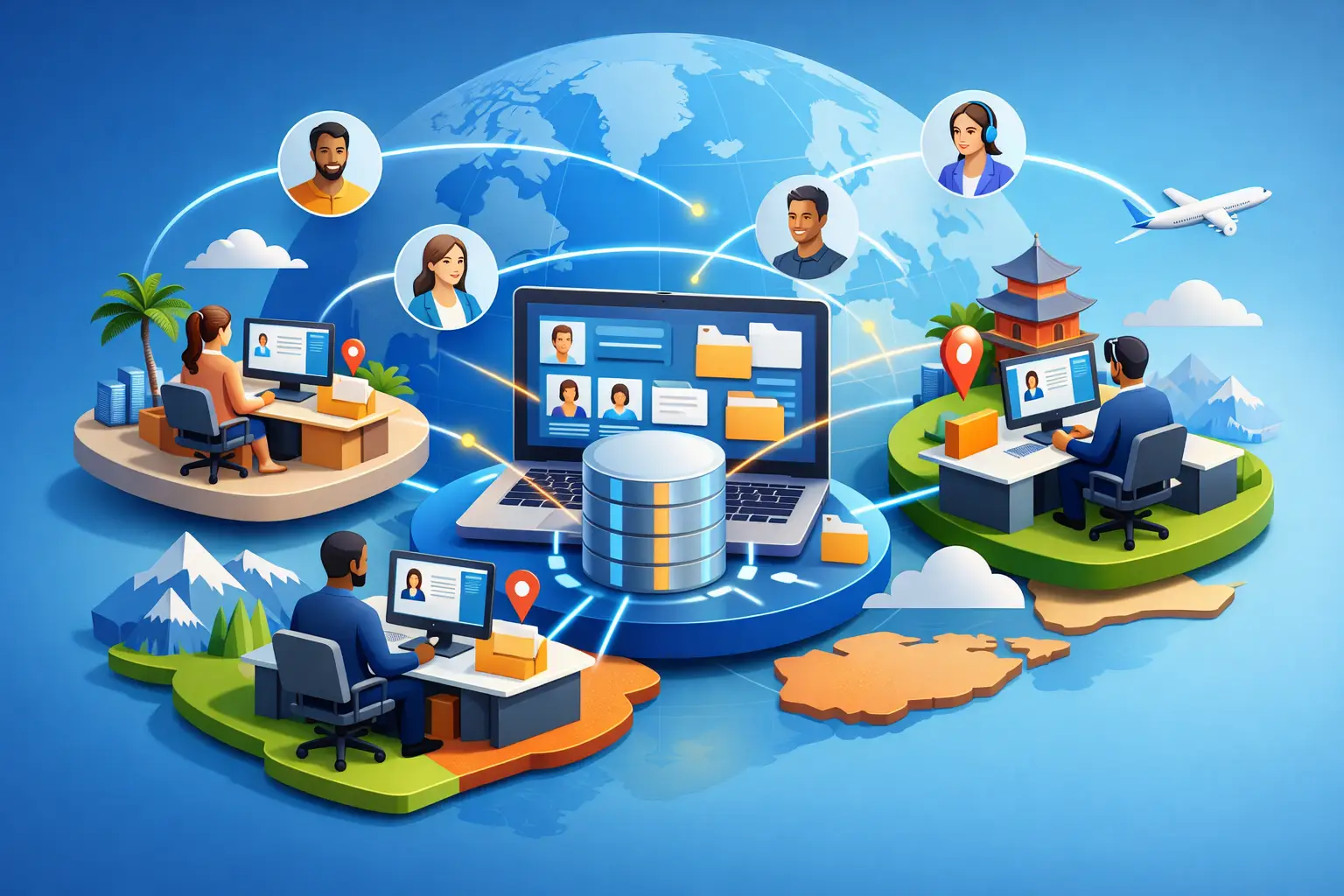
A payroll correction that starts with an outdated job title in HR, a missing bank detail in finance, or a leave balance stored in a spreadsheet is not a minor data issue. It is evidence that the organization does not have one employee record. It has several partial versions, each carrying operational and compliance risk.
For companies operating across countries, learning how to centralize employee records is not simply an HR systems project. It is the foundation for accurate payroll, controlled access, reliable reporting, faster onboarding, and defensible audit trails. The objective is not to move every document into one folder. It is to establish one governed system of record that keeps employee, organizational, payroll, and workforce data connected in real time.
What a centralized employee record actually means
A centralized employee record is a shared, governed profile that holds the authoritative data required to manage a worker throughout their lifecycle. That includes personal identity details, employment terms, legal entity, manager, location, compensation, tax and bank information, leave, time data, documents, and status changes.
Centralized does not mean every team has unrestricted access to every field. Payroll may need tax identifiers and bank details. A line manager may only need team structure, work schedule, leave status, and approved employment information. Finance may need cost center and compensation reporting without access to sensitive medical or personal documentation.
The distinction matters. A shared database without role-based access control is a security problem. A secure collection of disconnected tools is still a data problem. The right design delivers a single source of truth with field-level ownership, role-based permissions, and a complete audit trail.
For a multi-country business, the record must also account for local requirements. A Singapore employee, for example, may require payroll fields and statutory treatment that do not apply to a New Zealand employee. The shared model should retain a common global employee structure while country packs add jurisdiction-specific data, calculations, and filing requirements.
How to centralize employee records without creating another silo
Centralization succeeds when it is treated as an operating model, not a migration exercise. Start by identifying the systems that currently create, change, or consume employee data. Most organizations find records spread across HRIS tools, payroll software, applicant tracking systems, time clocks, benefits portals, learning platforms, spreadsheets, and finance systems.
The goal is not always to replace every application on day one. It is to decide which system owns each data domain and how updates move between systems. A composable architecture can keep specialized tools in place while preventing those tools from becoming independent sources of truth.
1. Define the authoritative data model
Begin with a practical inventory of employee data. Group fields by domain: identity, employment, organization, compensation, time, leave, payroll, benefits, talent, and compliance documents. Then assign an owner for each domain.
For example, Core HR should usually own legal name, employment status, manager, job, entity, and location. Payroll should own validated tax settings, payroll results, and statutory filing status. Time management should own approved attendance, overtime, and schedule data. The centralized platform should connect these domains through the same employee identity layer rather than copying them repeatedly.
This prevents a common failure mode: HR changes an employee’s location, but payroll continues using the prior jurisdiction because the systems synchronize only overnight, or not at all. Where data affects pay, compliance, or access, real-time updates or controlled workflow-based synchronization are safer than manual exports.
2. Clean data before migration, not after it
A centralized system will expose inconsistencies that fragmented tools allowed to persist. Duplicate employee IDs, expired contracts, inconsistent department names, missing emergency contacts, and unsupported job codes can all undermine reporting and workflow automation.
Before migration, establish data-quality rules. Require unique worker identifiers. Standardize legal entities, locations, cost centers, and job architecture. Identify mandatory fields by country and worker type. Archive records that no longer need to be active, while retaining them according to statutory and internal retention policies.
This work can feel slow, especially during a payroll or HR platform rollout. Skipping it is usually slower. Poor historical data creates exceptions in approvals, reporting, integrations, and gross-to-net processing long after implementation is supposedly complete.
3. Build lifecycle workflows around the record
Employee data should change through governed workflows, not through informal requests and spreadsheet edits. A new hire workflow should create the employee identity, collect required documents, assign an entity and location, provision access, establish a schedule, and send validated payroll information to the relevant country pack.
The same principle applies to promotions, transfers, manager changes, salary adjustments, leave events, and terminations. Each workflow should define who can initiate the change, who must approve it, which fields update, and what downstream systems receive the event.
This is where a connected platform changes the operating model. A legal entity transfer can update organizational reporting, payroll eligibility, tax treatment, time rules, and access policies from one approved event. Without that connection, teams are left reconciling the same change in several places.
4. Apply access controls that match real responsibilities
Employee records contain some of the organization’s most sensitive information. Centralization must be accompanied by security architecture, including role-based access control, single sign-on, approval controls, and auditable permissions.
A useful model separates access by role, entity, geography, and data sensitivity. HR business partners may manage employee records for assigned populations. Payroll administrators may access compensation and statutory data only for their countries. Managers may see direct-report information but not payroll bank details. Employees should be able to review and update appropriate self-service fields without changing controlled employment data.
For organizations using AI agents, the same controls must apply. AI should not become an ungoverned route into workforce data. Governed private agents need source citations, permission-aware retrieval, regional data controls, and logs of the actions they take. AI-native does not mean less control. It means intelligence operates within the same identity, policy, and audit framework as the rest of the platform.
5. Connect payroll, time, and organizational data
Payroll is often where fragmented employee records become expensive. Payroll teams need accurate employment status, pay rates, allowances, deductions, work location, tax settings, overtime, leave, and bank details. If any of these fields are maintained in separate tools, every payroll cycle includes reconciliation risk.
A centralized model connects approved time, attendance, leave, and compensation changes directly to payroll calculations. For businesses in APAC, the platform also needs localized country packs that apply the correct statutory logic, social insurance rules, year-end reporting, and native bank-file formats for each jurisdiction.
There are trade-offs. A global standard can simplify governance, but it cannot erase local employment and payroll requirements. The strongest approach uses common global definitions where possible and country-specific configurations where necessary. One codebase and a shared data model should support local compliance, not flatten it.
6. Integrate deliberately and monitor continuously
Centralization does not require a closed ecosystem. Most established organizations need employee data to flow to finance, recruiting, identity management, collaboration, and analytics tools. The difference is that integrations should be governed rather than improvised.
Use documented APIs, webhooks, OAuth2, and SAML SSO to connect systems with clear data contracts. Define whether each integration can only read data or can also write it back. Limit write access to approved workflows, and monitor failed synchronizations before they become payroll or access issues.
An open integration layer is particularly valuable during growth. A company may retain its existing applicant tracking system or ERP while consolidating the employee record at the point of hire. It can then add new entities, payroll countries, and operational tools without rebuilding the workforce data foundation each time.
Measure whether centralization is working
The best evidence is operational, not cosmetic. Track duplicate record rates, missing mandatory fields, payroll adjustments caused by data errors, time-to-provision for new hires, workflow completion rates, and the number of manual data exports used each month.
Also test reporting consistency. If HR, finance, and payroll produce different headcount totals or compensation figures for the same date, the source-of-truth model is incomplete. The answer may be a definition issue rather than a system issue, but centralized records make that gap visible and resolvable.
ZingKey is built around this principle: one composable system where Core HR, workforce operations, multi-country payroll, talent, rewards, analytics, integrations, and governed AI operate on a shared data model. The result is not merely fewer logins. It is a controlled employee identity that carries accurate context into every workforce decision.
Centralizing employee records is a long-term infrastructure decision. Treat the employee record as a live operational object, governed from hire through exit, and every downstream process has a better chance of being accurate, compliant, and ready for the next market you enter.