Workforce Intelligence for Cross-Border Operations
Workforce intelligence connects HR, payroll, time, and talent data so APAC leaders can make governed, real-time decisions across every entity globally.
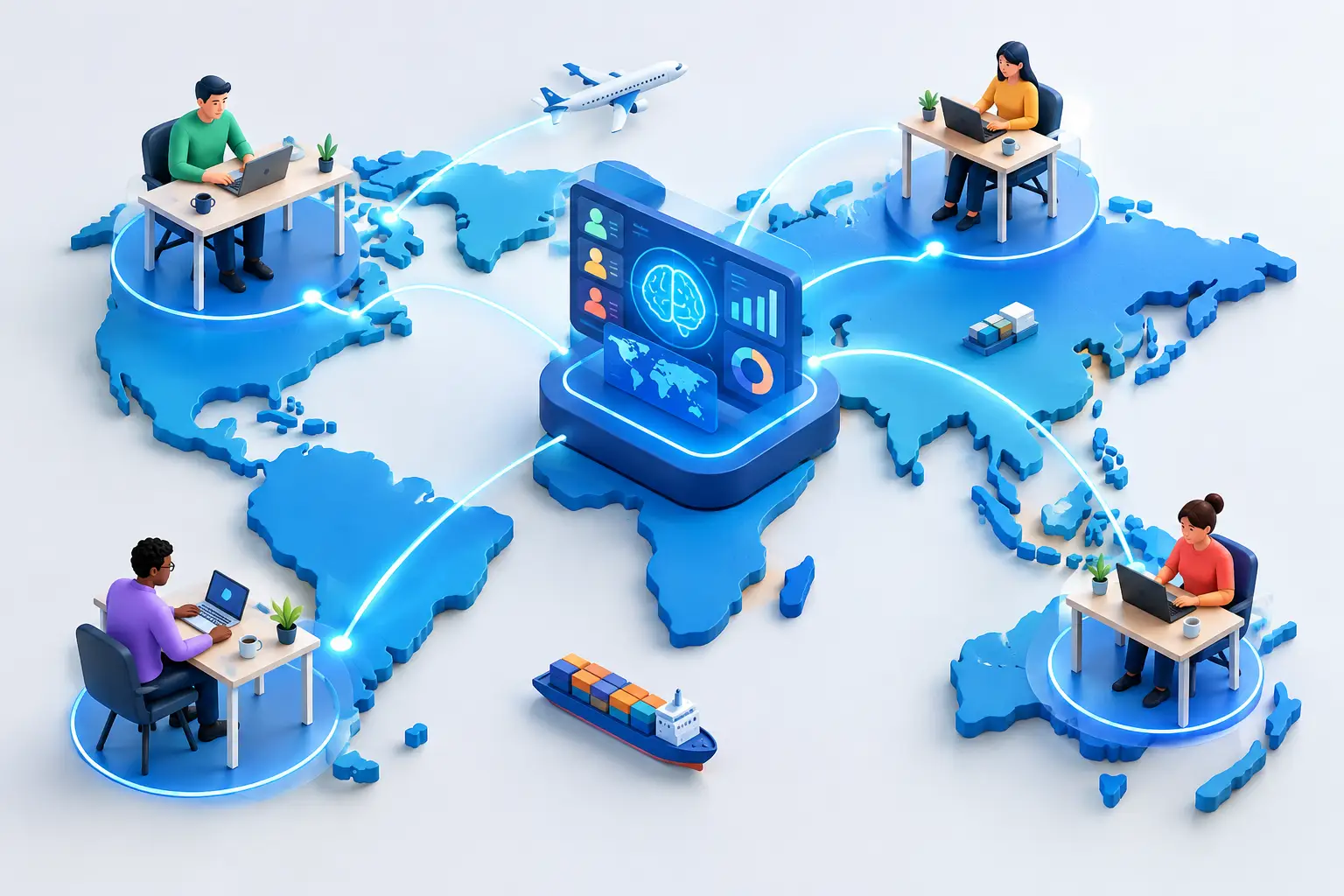
A payroll director sees 1,240 active employees in the payroll system. HR reports 1,276. Finance has budgeted for 1,301. None of these figures is necessarily wrong – they are answering different questions from different systems, at different points in time. This is the operational gap that workforce intelligence is designed to close.
For companies operating across entities, currencies, employment models, and statutory regimes, workforce intelligence is not another reporting layer. It is the ability to connect trusted people, payroll, time, talent, and financial data to make decisions from a consistent operational record. The distinction matters. A dashboard can expose a discrepancy. An intelligence layer should explain its source, show the affected population, and support a governed action to resolve it.
Workforce Intelligence Is an Operating Capability
Workforce intelligence combines data quality, shared definitions, analytics, and controlled workflows. It gives HR, payroll, finance, and IT teams a common way to understand the workforce while preserving the permissions and audit requirements each function needs.
A useful model starts with a simple question: can every workforce event be traced back to an authoritative employee identity? A new hire, leave request, schedule change, salary adjustment, promotion, overtime approval, and termination should update the same underlying record or synchronize through governed integrations. If the answer is no, reporting becomes a reconciliation exercise rather than a management capability.
This is especially consequential across borders. An employee may transfer from Singapore to Australia, change legal entity, receive a revised compensation package, and move to a different work schedule. Each event affects different processes: eligibility, manager hierarchy, local payroll calculations, statutory deductions, benefits, cost allocation, and access controls. If each process maintains its own employee record, teams inherit duplicate data, unclear ownership, and lagging reports.
A shared data model changes the equation. It lets an organization distinguish between a person, an employment relationship, a legal entity, a position, a cost center, and a payroll assignment. Those distinctions sound technical, but they prevent common failures, such as counting transfers twice, paying inactive employees, or applying a policy designed for one country to an employee in another.
It starts with consistent definitions
Headcount is a familiar example. Finance may define it as budgeted full-time equivalents. HR may count active employees. Payroll may count workers paid in the current cycle. Operations may need scheduled workers by location and shift. These are all valid views, but they should be named, versioned, and calculated from a common source of truth.
The same applies to turnover, absence, overtime, span of control, compensation cost, and time-to-productivity. Without clear definitions, a polished workforce dashboard can create more debate, not better decisions. Workforce intelligence gives metrics an operational contract: where the data originates, who can change it, how it is calculated, and when it was last refreshed.
Why Cross-Border Workforce Data Breaks Down
Fragmentation rarely begins as a strategic choice. A company adds a local payroll provider in a new market, adopts a recruiting tool, uses spreadsheets for compensation planning, and deploys a time system for shift-based teams. Each tool may work well in isolation. The problem emerges when a manager asks a question that crosses those boundaries.
Which teams are exceeding planned overtime while also carrying open roles? Which employees are eligible for a merit increase after a probation period ends? What is the fully loaded cost of a new customer support hub when statutory employer contributions differ by country? How many workers will be affected by a change in leave policy?
Answering those questions manually is slow, and manual processes weaken confidence in the result. By the time a team exports files, normalizes job titles, resolves duplicate records, and confirms the payroll period, the decision may have moved on.
Local compliance adds another layer. Payroll is not merely a payment output. It depends on jurisdiction-specific tax rules, social insurance calculations, statutory leave, reporting periods, and bank-file requirements. A global workforce view should not flatten those local rules into a generic data field. It should retain the country context that makes gross-to-net payroll accurate and reporting defensible.
For organizations in Singapore and New Zealand, for example, country-specific payroll logic must remain connected to employee changes upstream. The same principle applies as companies expand into Hong Kong, Australia, and other APAC markets. Central visibility is valuable only when local execution remains precise.
What Workforce Intelligence Should Connect
The first connection is between core HR and organizational structure. Employee records, legal entities, reporting lines, locations, departments, positions, and cost centers establish the dimensions that make workforce analysis meaningful. When organizational changes are reflected in real time, leaders can evaluate staffing by entity or function without rebuilding hierarchy data in a spreadsheet.
The second connection is between time, attendance, scheduling, and payroll. For hourly and shift-based workforces, approved time is a financial input. Schedules affect labor coverage, overtime exposure, and employee experience. Leave affects availability and pay. A workforce intelligence model should show where planned labor differs from worked labor, while preserving the approval trail behind each adjustment.
The third connection is between talent, rewards, and workforce cost. Recruiting demand, performance outcomes, learning activity, salary ranges, bonuses, and benefits should not sit apart from workforce planning. A high attrition rate has different implications if the affected jobs are scarce, if backfills take months, or if compensation is already outside market range. Connecting these signals helps leaders prioritize interventions rather than react to a single metric.
This does not mean every user should see every data point. Compensation details, performance feedback, medical leave, and payroll records require different access rules. Good workforce intelligence is governed by role-based access control, regional data controls, and an audit trail that records who viewed, changed, approved, or exported sensitive information.
From Visibility to Controlled Action
The strongest workforce intelligence systems do more than identify a condition. They initiate the right workflow with the right controls.
Consider a department where overtime rises for three consecutive pay periods. A basic analytics tool may flag the trend. An operational platform can trace the rise to schedules, absences, open requisitions, or a recent demand increase. It can route a review to the relevant manager, initiate a staffing request, or require approval before a schedule change affects payroll. The goal is not automated action for its own sake. The goal is shorter time from signal to accountable decision.
AI can accelerate this process, but only when it is attached to the system of record. AI-native, not bolted-on, means an agent can work within defined permissions, use approved sources, cite the records behind an answer, and log the action it takes. A public chatbot that summarizes an exported spreadsheet cannot provide that level of control.
For HR and payroll teams, governed AI can help answer operational questions, prepare exception reviews, draft employee communications, and route tasks. It should not bypass approval policies, invent policy interpretations, or expose data beyond a user’s role. The practical standard is straightforward: if a human cannot identify the source and audit the action, the automation is not ready for a regulated people process.
Architecture Determines Whether Insight Stays Current
Many organizations attempt to solve workforce intelligence with a data warehouse or business intelligence project. Those approaches can be valuable, particularly for enterprise-wide financial analysis. But they have a trade-off: data pipelines often introduce delays, transformation logic, and another place where definitions can diverge.
A composable workforce platform reduces that distance. Its modules can share identity, organizational data, workflow states, and permissions while APIs and webhooks connect specialist systems that still serve a purpose. The objective is not to force every process into one monolithic application. It is to establish one governed operational backbone.
That backbone should support practical enterprise requirements: REST and GraphQL APIs, OAuth2, SAML single sign-on, event-based integrations, audit logging, and clear data residency controls. These capabilities are not technical decoration. They determine whether IT can integrate the platform with finance, recruiting, identity, and collaboration systems without creating an unmanaged shadow process.
ZingKey approaches this as one composable system, connecting Core HR, multi-country payroll, workforce operations, talent, rewards, business intelligence, and governed AI through a shared data and identity layer. The result is a workforce view that can remain current as organizational events occur, rather than a report that must be rebuilt after the fact.
Build Workforce Intelligence Around Decisions
The right starting point is not a list of every available metric. Start with decisions that are currently slow, disputed, or high risk. Payroll directors may need a reliable view of changes that will affect the next pay run. Finance leaders may need labor cost by entity and cost center. People leaders may need to identify where retention risk and manager capacity overlap.
Next, define the authoritative source for each critical field and the workflow that updates it. Identify where employee identity is duplicated, where country-level rules are applied, and where approvals happen outside the system. This work can expose uncomfortable realities, but it prevents an analytics project from formalizing bad data.
Then establish the controls before expanding automation. Decide which roles can view compensation, approve time edits, trigger payroll-impacting changes, or ask AI agents to retrieve sensitive workforce information. Set retention rules, log high-impact actions, and test exceptions such as transfers, retroactive adjustments, and rehires. The edge cases reveal whether the operating model is dependable.
A useful workforce intelligence program earns trust one decision at a time. When the next headcount review, overtime exception, or payroll readiness check produces an answer that HR, finance, and payroll can all verify, the organization has more than better reporting. It has a more controlled way to run its workforce across every market it enters.