Which HR Tasks Suit AI? A Clear Decision Framework
Which HR tasks suit AI? Identify high-value workflows, preserve human judgment, and govern AI safely across multi-country HR and payroll operations now.
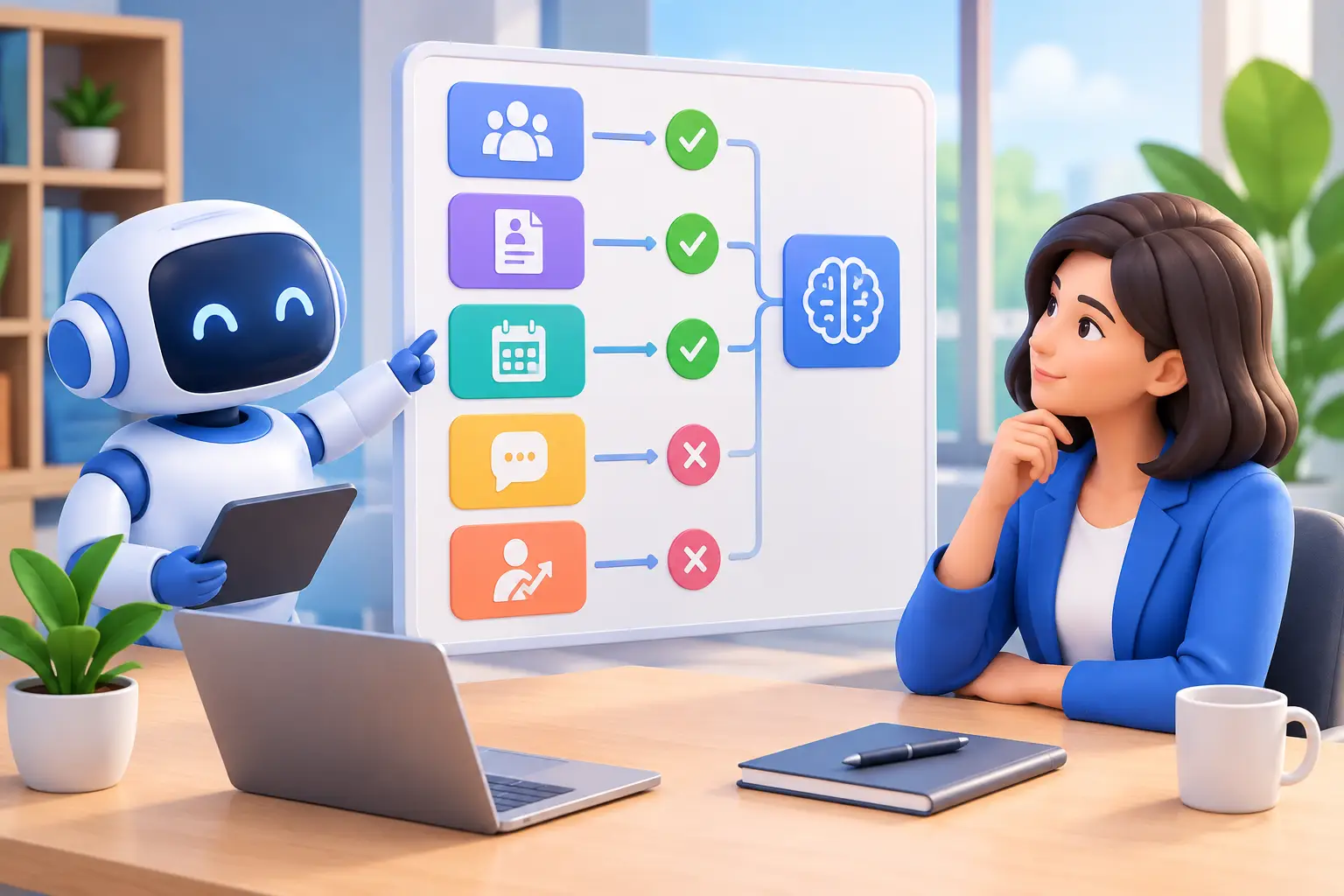
A payroll director should not have to spend the final two days before pay run answering the same questions about missing timesheets, leave balances, and cost-center changes. Nor should an HR business partner search across email, spreadsheets, and disconnected systems to confirm whether a policy applies in Singapore, New Zealand, or another jurisdiction. The question is not whether AI belongs in HR. It is which HR tasks suit AI without introducing risk, weakening accountability, or creating another layer of fragmented operations.
For multi-country organizations, the highest-value AI use cases are usually not the most visible ones. They are the repetitive, data-heavy decisions and actions that sit between employee records, workforce activity, policies, approvals, and payroll. AI performs well when it can retrieve governed information, identify exceptions, prepare a recommended action, and route that action through the right controls.
Which HR Tasks Suit AI Best?
A useful test is whether a task has four properties: a defined source of truth, repeatable rules, a clear owner, and an auditable outcome. If the answer is yes, AI can often reduce cycle time and administrative effort substantially. If the task involves ambiguous judgment, sensitive employee circumstances, or a consequential employment decision, AI should support the process rather than make the decision.
This distinction matters because HR is not a single workflow. It is a connected operating model that includes core employee data, time and attendance, schedules, leave, compensation, benefits, talent processes, payroll calculations, statutory reporting, and workforce analytics. An AI assistant working from incomplete or stale data can produce a polished answer that is operationally wrong. A governed AI agent connected to a shared data model can produce a useful answer with context, permissions, and an audit trail.
Employee service and policy answers
Employee self-service is one of the strongest starting points. AI can answer common questions about leave eligibility, approval status, pay dates, benefit enrollment windows, required documents, and internal policies. It can also summarize a policy in plain language or guide a manager through the correct workflow.
The control point is source grounding. The agent should retrieve answers from approved policy documents and current employee data, cite the source used, and respect role-based access control. An employee may see their own leave balance; a manager may see their team; payroll administrators may see payroll exceptions. Those boundaries cannot be optional.
For cross-border employers, the same question can have different answers by entity, location, worker type, or country pack. AI should therefore identify the employee context before responding, rather than treating a global handbook as the final authority.
Data quality, document processing, and workflow orchestration
AI is highly effective at work that is essential but rarely strategic on its own: detecting missing fields, classifying documents, extracting information from standardized forms, and preparing workflow actions. It can flag an employee record where a bank account update lacks approval, a job change has no effective date, or a work authorization document is approaching expiry.
It can also turn an unstructured request into a controlled workflow. A manager who writes, “Maria is moving to the Sydney team next month and her allowance changes,” should not need to understand every downstream configuration dependency. AI can identify the likely transfer, compensation, payroll, and access-management steps, then create a reviewable workflow for the appropriate owners.
The task is not to let AI silently alter the employee record. The task is to reduce the manual interpretation and handoff work that delays a correct change. Effective design separates recommendation, approval, and execution, with timestamps and audit logging at every stage.
Payroll readiness and exception management
Payroll is an especially valuable area for AI assistance, but it is also where governance must be most disciplined. AI should not invent payroll rules or independently approve a gross-to-net result. It can, however, transform payroll preparation.
Before a pay run, AI can identify late time entries, unexpected overtime, duplicate allowances, retroactive changes, unapproved leave, terminated employees still included in a cycle, or large pay variances against prior periods. It can group exceptions by root cause and direct them to the manager, HR, finance, or payroll owner who can resolve them.
This is more useful than a generic anomaly alert. A payroll team needs an explanation tied to the underlying workforce record, schedule, timesheet, compensation change, and local statutory logic. In a multi-country environment, that context must include the applicable jurisdiction. Country-specific tax, social insurance, reporting, and bank-file requirements remain deterministic controls within the payroll engine, not prompts for a general-purpose model to interpret.
Workforce intelligence and manager support
AI can make workforce data easier to act on. Instead of requiring a people analyst to build every report manually, leaders can ask operational questions in natural language: Which teams have the highest overtime variance? Where are leave patterns affecting coverage? Which open requisitions have remained inactive beyond target? What changed in headcount and labor cost this quarter?
The best output is not just a narrative. It should show the definitions, filters, source data, and calculation logic behind the answer. Finance and HR leaders need to know whether headcount means active employees, full-time equivalents, or all workers assigned to a legal entity. AI can accelerate analysis, but the metrics must remain governed.
Manager support is another practical use case. AI can draft role-specific checklists for onboarding, probation reviews, return-to-work workflows, or performance conversations. It can summarize documented goals and feedback for a manager preparing for a review. The manager remains responsible for the conversation, the assessment, and the final record.
Tasks Where AI Should Assist, Not Decide
The closer a task gets to an employment outcome, the more carefully AI should be constrained. Hiring shortlists, performance ratings, promotion decisions, disciplinary action, accommodation requests, and termination recommendations involve context that may not be complete in a system of record. They can also carry legal, ethical, and employee-relations consequences.
AI may help organize evidence, surface missing documentation, standardize a process, or draft a manager brief. It should not be the sole decision-maker. A human owner must review the relevant facts, apply company policy and local law, and document the rationale.
The same applies to compensation. AI can model budget scenarios, identify pay changes that fall outside approved ranges, and prepare compensation-cycle summaries. It should not autonomously set an employee’s salary or recommend an adjustment without clear controls, approved data, and accountable human review.
The Architecture Determines Whether HR AI Is Useful
A chatbot connected only to documents can answer basic questions. It cannot reliably coordinate a job change that affects reporting lines, time rules, benefits, access, payroll, and financial reporting. HR AI becomes operational when it works across one shared identity layer and a current workforce data model.
That is why AI-native, not bolted-on, architecture matters. The AI layer needs permission-aware access to the same records and workflows used by Core HR, payroll, time management, talent, and analytics. It also needs defined action boundaries: what it can read, what it can draft, what it can submit for approval, and what it must never execute.
For example, ZingKey can apply governed AI agents to source-grounded HR tasks while maintaining role-based permissions, regional data controls, and an audit trail. The value is not a conversational interface alone. It is controlled action across a composable system, where the answer and the workflow draw from the same underlying data.
Start With a Controlled Operating Model
Organizations should begin with a narrow use case that has measurable friction, such as employee policy questions, missing-data remediation, payroll exception triage, or onboarding workflow preparation. Define the source systems, user roles, approval points, and escalation path before deployment.
Then measure operational outcomes: time to resolve a case, payroll exceptions cleared before cutoff, reduction in manual data corrections, manager completion rates, and audit findings. Accuracy should be evaluated by country, entity, employee type, and workflow, not as one global average. A model that performs well for a simple leave question may be unsuitable for a statutory payroll scenario.
AI earns trust when it makes work more controlled, not merely faster. Choose tasks where the data is authoritative, the action is bounded, and a named owner can verify the result. That is how HR teams create capacity for the work that still requires judgment: supporting people, resolving complex cases, and making accountable decisions.