HRIS Versus Spreadsheets: When to Make the Shift
HRIS versus spreadsheets: compare data control, payroll accuracy, compliance, and scale to see when your workforce needs one connected operating system.
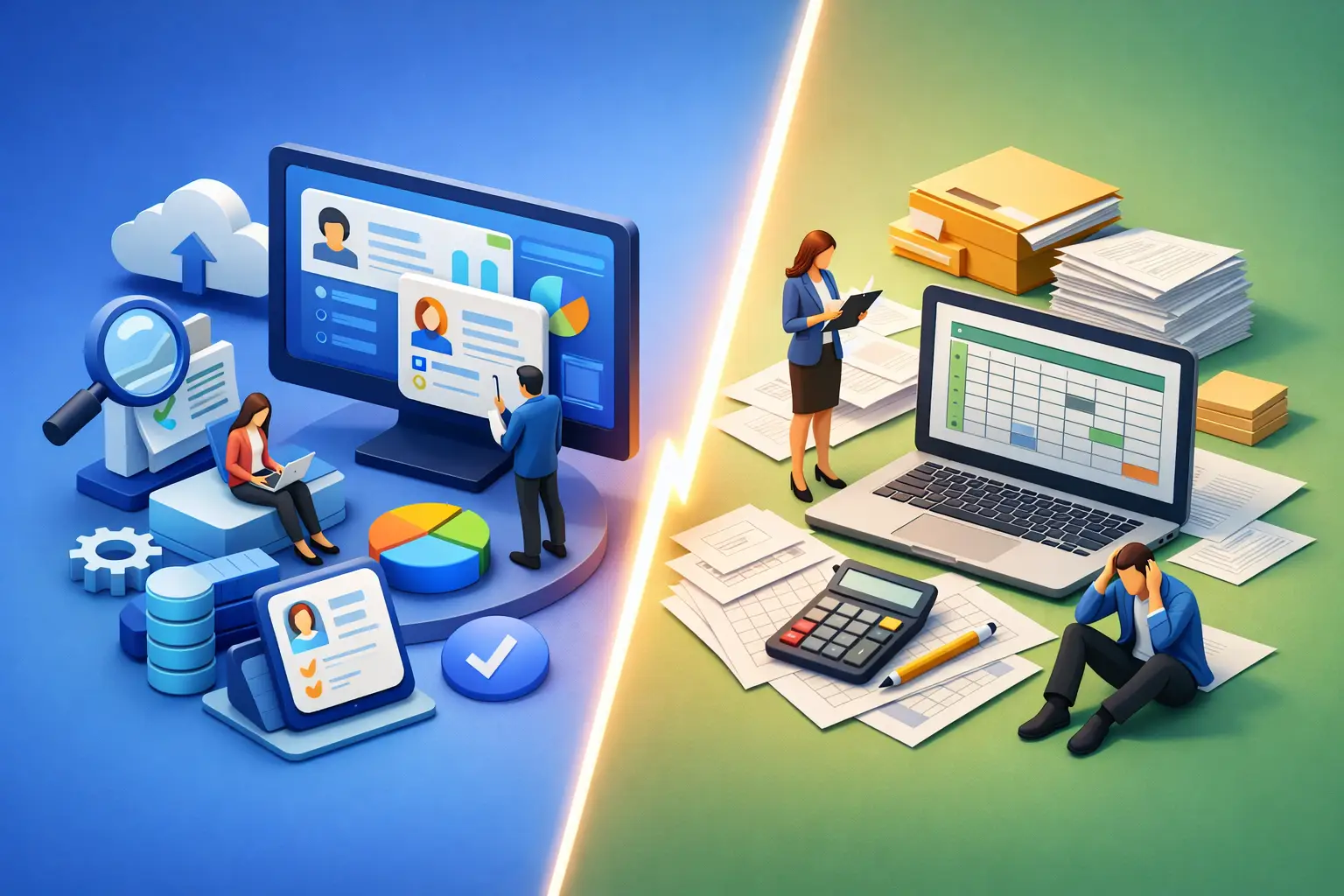
A payroll correction made at 4:45 p.m. should not require someone to find the latest version of a workbook, trace a formula across five tabs, and ask whether the employee’s leave balance changed after the file was exported. Yet this is how many growing companies still run critical people operations. The question of HRIS versus spreadsheets is not about whether spreadsheets are useful. It is about whether they remain a safe operating layer for employee, payroll, and compliance data as the business grows.
For a small, single-country team with stable headcount, a carefully managed spreadsheet can be practical. Once multiple legal entities, managers, pay cycles, leave policies, and jurisdictions enter the picture, its limits become operational risk. The shift to an HRIS is less about replacing a familiar tool and more about establishing a controlled system of record.
HRIS versus spreadsheets: the real difference
A spreadsheet is a flexible file. An HRIS is an operational system. That distinction affects how data is entered, changed, approved, secured, calculated, and reported.
In a spreadsheet, the employee record is usually distributed. Personal details may sit in one workbook, compensation in another, time records in a scheduling tool, recruiting data in an ATS, and payroll inputs in a country-specific file. Teams can make this work through discipline, but the process depends on people remembering which source is current and manually reconciling exceptions.
An HRIS treats the employee profile, organizational structure, employment terms, leave, time, compensation, and lifecycle events as connected data. A job change can update the manager hierarchy, approval routing, compensation history, payroll inputs, and reporting permissions according to defined rules. The point is not merely digitizing forms. It is maintaining one source of truth as workforce data moves through the organization.
That connection matters most when a data change has consequences beyond HR. A new hire affects equipment provisioning, payroll enrollment, benefits eligibility, cost-center reporting, and access controls. A termination affects final pay, leave payout, document retention, and system access. Spreadsheets can track each step, but they cannot reliably enforce the workflow across every dependent system.
Where spreadsheets still make sense
Spreadsheets are not the wrong answer for every task. They are effective for ad hoc scenario modeling, one-time analysis, budget drafts, and localized calculations that do not become a recurring system of record. Finance teams may use them to model a proposed compensation cycle. HR teams may use them to test headcount plans before approved roles enter the HR system.
The trouble begins when an ad hoc file becomes permanent infrastructure. This usually happens quietly: a payroll adjustment tracker is reused each month, a leave file becomes the manager’s reference, or a compensation worksheet becomes the only reliable record of historical changes. The file may be well designed, but it lacks controlled identity, workflow states, and reliable dependency management.
A useful test is simple: if a spreadsheet contains data that must be correct for payroll, statutory reporting, employee entitlement, or an audit, it should not be the authoritative source. It may still be an analysis layer, but the governed record belongs in a system designed for the work.
The operational cost of manual reconciliation
The visible cost of spreadsheet-based HR is administration. The more serious cost is the reconciliation work no one plans for. People operations checks whether the headcount list matches payroll. Payroll verifies that overtime, unpaid leave, and salary changes were included. Finance investigates why monthly labor cost differs from forecast. IT confirms whether a leaver still has active accounts.
Each comparison can look minor in isolation. Across countries and entities, they create a recurring control problem. A different employee ID format, an overwritten formula, or a file shared without version discipline can produce errors that surface only after payroll closes or a regulator requests evidence.
An HRIS reduces this burden by connecting workflows to shared records. It can apply role-based access control so managers see their team data, payroll administrators see required payroll fields, and finance receives approved outputs without broad access to sensitive personal information. Audit trails establish who changed a record, when it changed, and what approval supported it. These controls are difficult to reproduce consistently in files passed between teams.
Payroll and compliance change the decision
For organizations operating across Singapore, New Zealand, Hong Kong, Australia, or additional APAC markets, payroll is where the spreadsheet model becomes particularly fragile. Gross-to-net calculations are not just arithmetic. They rely on local tax treatment, social insurance rules, leave treatment, reporting obligations, filing deadlines, and bank-file requirements that can vary by country and change over time.
A spreadsheet can calculate payroll if the right formulas and assumptions are maintained. But calculation is only one part of payroll control. The organization also needs a clear record of employment terms, approved time and attendance inputs, statutory configuration, exceptions, approvals, and payment outputs. When these inputs live across disconnected files and tools, payroll teams inherit the job of proving that each figure is current and authorized.
A multi-country HRIS with country packs places jurisdiction-specific logic closer to the source data. It can connect employment changes, time data, leave, and compensation directly to payroll processing while preserving local rules and audit evidence. That does not eliminate the need for payroll expertise. It gives payroll experts a controlled environment in which their expertise is applied.
Data governance is not an IT afterthought
Employee data contains compensation, identity, medical or leave-related information, bank details, and employment documentation. A spreadsheet shared through email or a general drive can create access exposure even when the team has good intentions. Permissions may be folder-based rather than field-based, copies can persist after access is removed, and it can be difficult to determine which version informed a decision.
An HRIS supports governance as part of the operating model. Role-based permissions can limit access by function, legal entity, geography, or management hierarchy. SSO and identity controls can align HR access with the company’s wider security standards. Audit logging creates evidence for sensitive changes, while APIs and webhooks allow data to move to finance, IT, recruiting, and analytics systems without repeated manual exports.
AI raises the standard further. A public AI tool fed with copied employee data creates obvious governance questions. Governed private AI agents, by contrast, can operate within permissions, cite source records, respect regional data controls, and log actions. The relevant question is not whether AI can answer an HR question. It is whether the answer and any resulting action are based on authorized, traceable workforce data.
Signs your organization has outgrown spreadsheets
The clearest signal is not headcount alone. A 75-person company with three countries and hourly workers may need a connected system sooner than a 300-person company with one entity and simple salaried payroll.
The case for an HRIS strengthens when payroll relies on repeated manual imports; managers cannot see a current team view; HR and finance report different headcount numbers; approvals are tracked in email; employees request basic information because they cannot self-serve; or an audit requires assembling evidence from multiple files. These are symptoms of a fragmented data model, not just an inefficient process.
Another signal is expansion. Entering a new market should not require building a new workbook architecture, recreating approval chains, and teaching another team which tabs must be updated. Companies that scale across borders need a core employee identity and organizational model that can support local country requirements without fragmenting the platform.
What to evaluate before moving to an HRIS
Do not treat the migration as a feature checklist exercise. Start with the data and decisions that matter most: who owns the employee record, which events trigger payroll changes, how approvals flow, which systems need workforce data, and what compliance evidence must be retained.
Then assess whether the platform can support your actual operating model. For multi-country organizations, that includes native payroll coverage and local statutory logic, not just the ability to store a country field. For IT, it includes APIs, OAuth2, SAML SSO, integration options, audit logging, and permission design. For finance, it includes clean organizational structures, cost centers, approved payroll outputs, and dependable workforce reporting.
A composable approach is often the practical path. Core HR may be the first deployment, followed by time management, payroll, talent, rewards, and advanced analytics as the organization is ready. The essential requirement is that every module works from a shared data model rather than creating another disconnected database. ZingKey is designed around this principle: one composable system where workforce operations, payroll, and governed AI act on the same record.
A spreadsheet will always have a place on the analyst’s desktop. It should not be the control plane for a distributed workforce. When employee data drives pay, compliance, access, and management decisions, the organization needs more than formulas. It needs accountable workflows, governed data, and a system that can grow with every new entity and country.