AI Hiring Risks That Break Trust and Compliance
AI hiring risks increase when recruiting data, automation, and decision authority are disconnected. Build workflows that keep hiring fair and auditable.
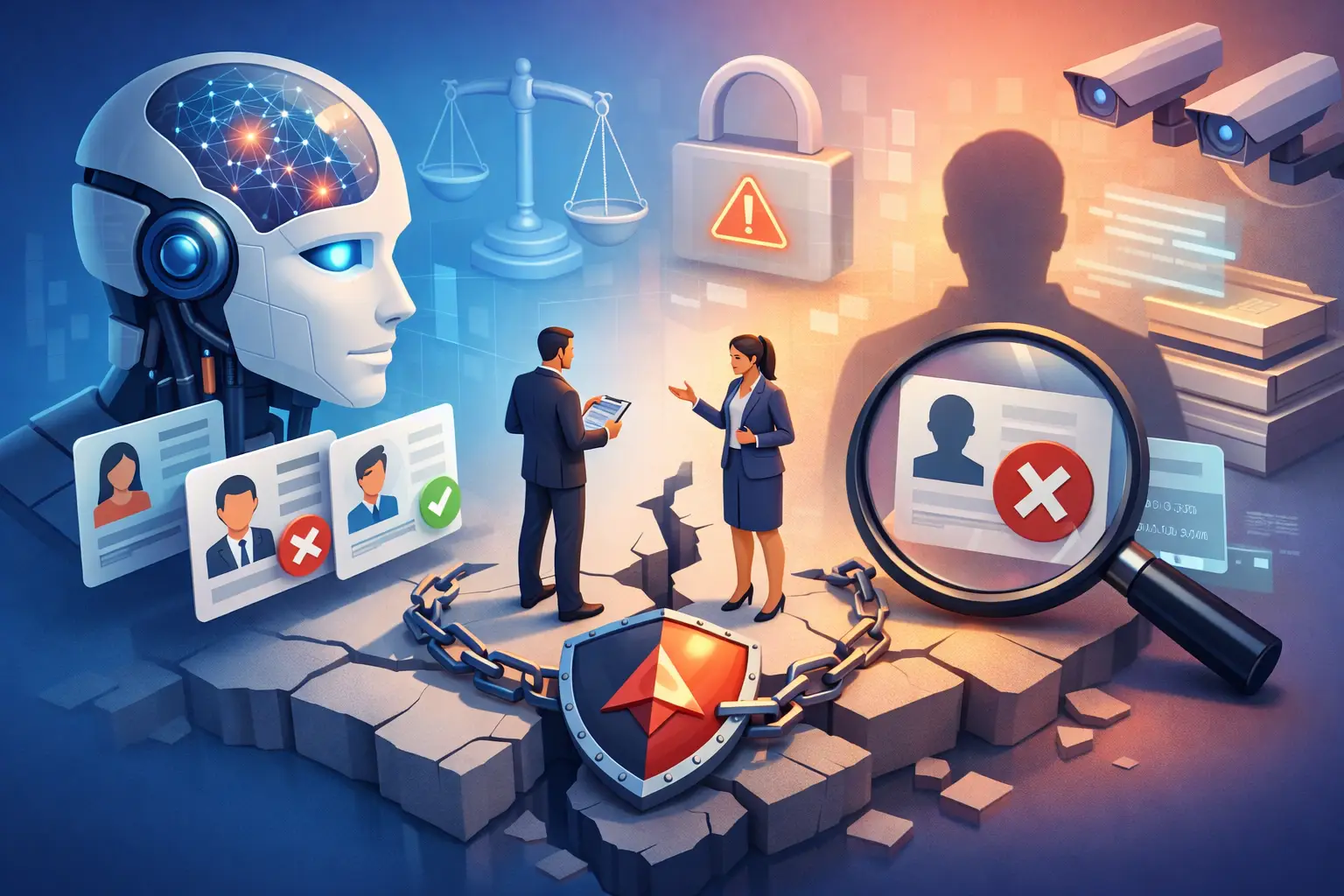
A recruiting team can add an AI screening tool in a week. Reversing a flawed rejection decision, explaining it to a candidate, or defending it to a regulator can take far longer. AI hiring risks emerge when automation is treated as a productivity feature rather than a controlled decision system connected to accurate people data, clear ownership, and a complete audit trail.
For organizations hiring across countries, the exposure is not limited to biased recommendations. Candidate data may cross borders without an approved basis. A model may use signals that are unavailable, unreliable, or inappropriate in a local market. A recruiter may assume a score is objective because it arrived through software. The result is a process that moves faster while becoming harder to explain.
Where AI hiring risks actually start
The most visible risk is discrimination. If an AI tool learns from historical hiring data, it can reproduce patterns created by past preferences, uneven access to education, inconsistent job descriptions, or manager bias. Even when protected characteristics are excluded from a model, proxy variables can remain. Location, employment gaps, school names, language patterns, and career paths may correlate with characteristics an employer should not use to make employment decisions.
But bias is only one layer. Many hiring failures begin earlier, in the operating model. Recruiting data sits in one system, interview feedback in another, compensation approvals in email, and employee records in a separate HR platform. An AI layer placed over that fragmented environment may generate recommendations from incomplete context, stale requisition details, or duplicate candidate records.
The central question is not whether AI is involved. It is whether the organization can identify what data informed a recommendation, who reviewed it, what action was taken, and why.
Automation can create false certainty
AI-generated candidate summaries, skills matches, rankings, and interview questions can be useful. They can also make a weak signal look precise. A ranking of 87 out of 100 may imply a level of measurement that the underlying data cannot support.
This is particularly risky for roles with inconsistent job architecture. If a job description combines essential requirements with preferences, or if hiring managers define success differently across regions, an AI tool will amplify ambiguity at scale. The issue is not a technical defect alone. It is a governance failure around role design, data quality, and decision rights.
Human review helps, but only when it is meaningful. A recruiter who has no visibility into the logic, no authority to override it, or no time to challenge hundreds of recommendations is not providing effective oversight. Human-in-the-loop cannot be a label applied after deployment. It must be designed into the workflow.
The compliance exposure is broader than applicant tracking
Hiring decisions sit at the intersection of employment law, privacy law, recordkeeping obligations, and internal controls. Requirements vary by jurisdiction, and multinational employers need to account for the location of the candidate, the employing entity, the system provider, and the data-processing environment.
Candidate data deserves the same discipline as employee data. Resumes, assessments, interview notes, identity details, compensation expectations, and background-check information can be sensitive. AI tools may also infer information from unstructured content. That makes data minimization, retention schedules, access controls, and regional processing rules operational requirements, not legal footnotes.
A platform should make it possible to answer basic questions quickly: Which users accessed candidate records? Was information exported to an external model? Which version of the workflow was active when the decision occurred? Was a candidate notified about automated processing where required? If those answers require stitching together vendor tickets, inboxes, and spreadsheets, the control environment is already weak.
Cross-border hiring raises the control standard
A candidate pipeline can span Singapore, New Zealand, Australia, Hong Kong, and the United States while the hiring team works from a different country. Local language, credential norms, work authorization requirements, and compensation practices can differ significantly. A model trained primarily on one market may not transfer cleanly to another.
This does not mean organizations should abandon AI in recruiting. It means they should avoid assuming that one model, one scoring threshold, or one workflow is appropriate everywhere. Local policy controls should sit alongside a shared global process. The objective is consistency in governance, not identical treatment regardless of context.
For HR, finance, and IT leaders, this is where a unified workforce architecture matters. Recruiting should not operate as an isolated data island that hands off incomplete records at offer acceptance. A connected system can carry approved role data, legal entity details, compensation bands, hiring approvals, and identity controls through the employee lifecycle without repeated manual entry.
Build a controlled AI hiring workflow
The right design starts with a simple principle: AI can assist with bounded tasks, but accountable people must retain authority over employment decisions. Organizations should define where AI is permitted to summarize, draft, classify, or flag exceptions, and where it must not autonomously reject, rank, or select candidates.
The strongest workflows connect controls to the actual work of recruiting rather than storing them in a policy document. That includes clear job requirements, approved evaluation criteria, structured interviewer feedback, and documented approval paths for exceptions.
A practical control model has five parts:
- Purpose limitation: Define the specific hiring task the AI supports and prohibit secondary use of candidate data without review.
- Data controls: Limit inputs to relevant, current data; apply role-based access controls; and set retention and deletion rules for applicant records.
- Decision controls: Require human review for material decisions, with a documented override process and escalation path.
- Evidence controls: Record source data, model or prompt outputs, reviewer actions, approval timestamps, and changes to workflow rules.
- Monitoring controls: Test outcomes for adverse impact, false positives, inconsistent recommendations, and regional performance differences on a recurring schedule.
Not every workflow requires the same level of scrutiny. Using AI to draft a candidate outreach email carries a different risk profile from using it to recommend who advances to a final interview. The higher the impact on an employment decision, the stronger the validation, review, and documentation should be.
Data quality is a hiring control
Recruiting leaders often treat clean data as a reporting objective. With AI, it becomes a decision-quality objective. Inconsistent job titles, unstandardized skills, missing interview feedback, and unapproved compensation ranges create noisy inputs. No model can produce a reliable recommendation from a vague requisition or an incomplete candidate record.
This is why shared data models matter. When core HR, talent management, total rewards, and workforce operations operate from one source of truth, recruiting teams can use approved organizational structures and job data rather than recreating them in a disconnected applicant tracking process. Finance can see whether headcount and compensation approvals align. IT can enforce identity, SSO, and access policies consistently. Compliance teams can retrieve evidence without reconstructing a decision after the fact.
ZingKey approaches this as an AI-native workforce operating model: private AI agents can perform defined HR tasks within role-based permissions, regional data controls, source citations, and audit logs. The distinction is material. AI that operates inside governed workforce infrastructure is easier to supervise than AI that copies sensitive data into uncontrolled tools.
Questions to ask before deployment
Before enabling an AI recruiting capability, leaders should ask whether the vendor can explain the system in operational terms, not just marketing terms. What inputs does it use? Can the organization turn off specific features or data sources? Is candidate data used to train shared models? How are outputs logged? Can administrators set permissions by role, entity, or region? What happens when an integration sends incorrect or outdated data?
The internal questions matter just as much. Who owns model oversight: talent acquisition, HR, legal, IT, or a cross-functional governance group? How often will outcomes be reviewed? What is the process when a candidate challenges a decision? Which metrics indicate that the system is improving recruiter capacity without degrading fairness or quality?
A useful starting point is to pilot AI on high-volume, low-impact tasks such as interview-note summaries, requisition drafting, candidate communication, or scheduling support. Measure quality, time saved, exception rates, and recruiter overrides before extending automation to more consequential recommendations.
Hiring is a high-trust process. The companies that use AI well will not be the ones that automate the most decisions. They will be the ones that make every assisted decision traceable, challengeable, and grounded in reliable workforce data.