HR Technology Trends Reshaping Workforce Ops
HR technology trends are shifting from isolated tools to governed workforce systems that connect payroll, AI, data, and compliance across borders reliably.
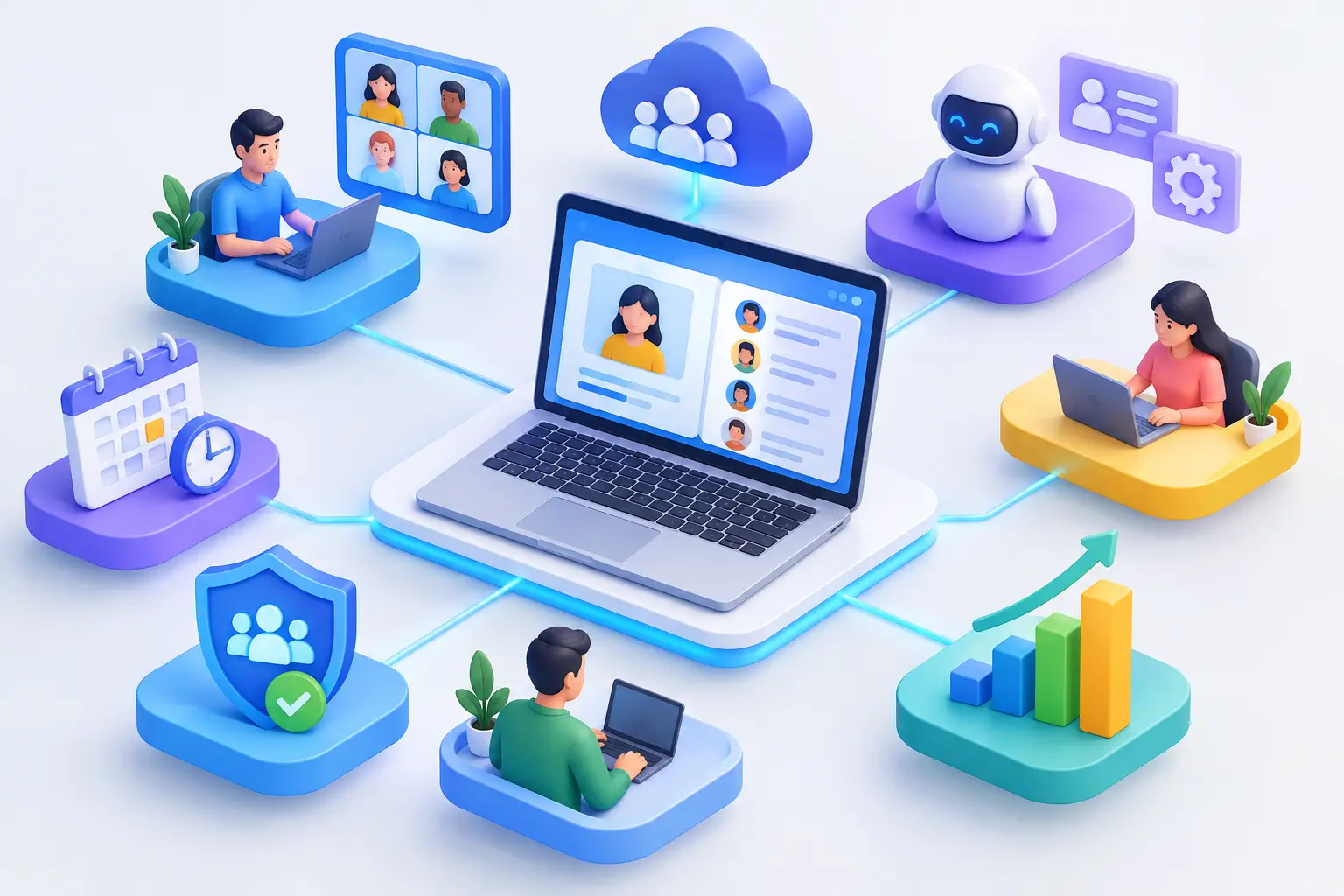
A payroll variance discovered two days before pay run is rarely a payroll-only problem. It may start with an outdated employee record, an unapproved schedule change, a leave balance held in another system, or a manager workflow that never reached the right approver. The most consequential HR technology trends address this operational chain, not just individual HR tasks. For organizations operating across countries, the priority is moving from disconnected applications to controlled workforce infrastructure.
The market is not simply adding more AI features or employee self-service portals. It is changing the architecture behind workforce operations: where data lives, how policy is applied, who can authorize action, and how every outcome can be explained. That distinction matters to HR, payroll, finance, IT, and compliance teams because a local process failure can quickly become a cross-border reporting, payment, or audit issue.
HR Technology Trends Are Moving to Connected Systems
For years, many organizations assembled their HR stack one use case at a time. A core HR system managed employee records. A separate time tool captured attendance. Local payroll providers calculated pay. Recruiting, performance, benefits, and learning lived elsewhere. Each application could be competent on its own, yet the organization carried the cost of synchronization, duplicate identities, manual exports, and reconciliation.
The stronger direction is a composable platform with a shared data model and identity layer. This does not mean every organization must buy every module from one vendor. It means the systems that govern employee status, organizational structure, pay inputs, time, and approvals need a reliable source of truth and clear integration contracts.
A shared worker record changes the quality of downstream operations. When a legal entity transfer, manager change, compensation update, or leave event is approved, payroll, workforce planning, reporting, and access controls can act on the same event. Teams spend less time asking which spreadsheet is current and more time resolving exceptions that require judgment.
This trend also raises the standard for integrations. Basic file imports are not enough for complex operations. Enterprise teams increasingly expect REST and GraphQL APIs, webhooks, OAuth2, SAML SSO, role-based access control, and audit logging. These are not technical extras. They determine whether HR operations can connect safely with finance platforms, identity providers, applicant tracking systems, collaboration tools, and local banking workflows.
AI Is Becoming a Governed Operating Layer
AI is the most visible of the current HR technology trends, but generic copilots are not the operational answer. An AI tool that produces polished text while lacking access controls, source evidence, and action boundaries can increase risk rather than reduce work.
The enterprise use case is governed AI that operates within the workforce system. A private AI agent should understand the user requesting help, the records that user is authorized to see, the country policy that applies, and the workflow required before a change takes effect. It should cite the source record or policy behind an answer and maintain an audit trail of the request, response, and action.
Consider a people operations manager investigating an overtime exception. A useful agent can identify the relevant schedule, approved timesheet entries, local overtime rule, and pending approval without exposing unrelated compensation data. It can prepare a correction workflow, but it should not silently alter payroll inputs. The right balance is automation with controlled human authority.
This is where AI-native design differs from AI bolted onto a legacy database. AI-native systems are designed around current data, permissions, regional controls, and workflow states from the beginning. The result is not merely faster drafting of job descriptions or employee announcements. It is faster case resolution, better policy retrieval, cleaner approvals, and fewer handoffs across HR and payroll teams.
The trade-off is implementation discipline. Organizations need to define which actions an agent may perform, which require approval, what data may cross regional boundaries, and how exceptions are monitored. AI governance is a workforce operations requirement, not a legal review saved for after deployment.
Payroll, Time, and Compliance Are Converging
Multi-country payroll is becoming more tightly connected to workforce time and core HR because the inputs are inseparable. Pay depends on employee eligibility, contract terms, work location, leave, attendance, overtime, variable compensation, and statutory rules. When these data points move through separate tools, the payroll team becomes the final reconciliation layer.
Country-pack payroll models are gaining ground because they package jurisdiction-specific tax, social insurance, statutory reporting, year-end requirements, and bank-file formats into the operating platform. This is particularly valuable for companies expanding across Singapore, New Zealand, Hong Kong, Australia, and other APAC markets, where payroll obligations cannot be safely standardized through one global rule set.
A country pack should not be confused with a collection of configurable fields. It needs maintained calculation logic, localized reporting, and a clear change-management process when legislation changes. Finance leaders should ask how statutory updates are applied, how historical calculations are preserved, and whether the system can explain gross-to-net results at the employee level.
Workforce management is following the same path. Scheduling, attendance, breaks, leave, shift premiums, and overtime are operational inputs to pay, not peripheral HR data. The closer these processes are connected, the easier it becomes to catch issues before payroll closes. That matters most in industries with hourly workforces, variable schedules, multiple locations, or a mix of employee types.
Workforce Data Is Becoming an Executive Control Plane
The value of a unified workforce record extends beyond administrative efficiency. It creates a dependable control plane for decisions about headcount, labor cost, turnover, manager spans, compensation, and capacity.
Business intelligence only becomes credible when the underlying organizational data is current and consistently defined. If one report counts contingent workers and another does not, or if cost center changes take weeks to reach payroll, leadership receives a distorted view of the business. Real-time reporting is useful only when its definitions, source data, and permissions are governed.
For finance, this creates a clearer connection between planned headcount and actual labor spend. For HR, it makes workforce metrics more actionable because the team can trace a trend back to organizational events and employee lifecycle data. For IT and compliance, it reduces the number of unmanaged exports that proliferate when teams cannot obtain trusted answers from the system of record.
Data residency remains a practical consideration. A global workforce platform needs regional data controls that support local requirements without creating isolated data silos that make reporting and governance impossible. The appropriate model depends on the countries involved, internal policy, and regulatory obligations, but the decision should be architectural rather than improvised during an audit.
How to Evaluate the Next HR Technology Stack
The best evaluation starts with operating flows, not feature checklists. Map what happens when an employee joins, changes role, moves entity, takes leave, works overtime, receives a compensation adjustment, or exits. Identify where data is created, who approves it, what payroll or finance process consumes it, and how the organization proves the decision later.
Then test prospective platforms against the failure points. Can a manager change trigger the correct permissions and workflow? Can a retroactive time correction be traced into a payroll adjustment? Can a payroll director see why a calculation changed? Can an administrator limit access by role, entity, and region? Can the platform exchange data with the systems the organization will retain?
Companies should also separate platform breadth from platform coherence. A long module list is less valuable if every module maintains its own employee identity, approval logic, or reporting definitions. One composable system should allow organizations to adopt capabilities in phases while retaining one codebase, shared data, and consistent controls.
ZingKey reflects this direction by bringing core HR, multi-country payroll, workforce operations, talent, rewards, business intelligence, integrations, and governed AI into a connected platform. For buyers, the relevant question is not whether every capability is needed on day one. It is whether the foundation can support the next country, legal entity, workforce model, or compliance requirement without adding another reconciliation problem.
Build for the Exception, Not the Demo
Most HR platforms look effective when the employee record is simple and the workflow follows the standard path. The real test is the exception: a cross-border transfer during a payroll cycle, a late overtime correction, a statutory rule update, or an AI request involving sensitive data. Select technology that makes those moments visible, authorized, and traceable.
The organizations that gain the most from these shifts will treat HR technology as operating infrastructure. Start with the workforce events that create the most risk or manual effort, establish accountable data ownership, and make every automation explainable. That is how HR, payroll, finance, and IT can scale together without losing control.