Cloud Payroll Comparison for Multi-Country Teams
A cloud payroll comparison for multi-country teams: assess compliance, data architecture, workflow controls, integrations, and AI governance before buying
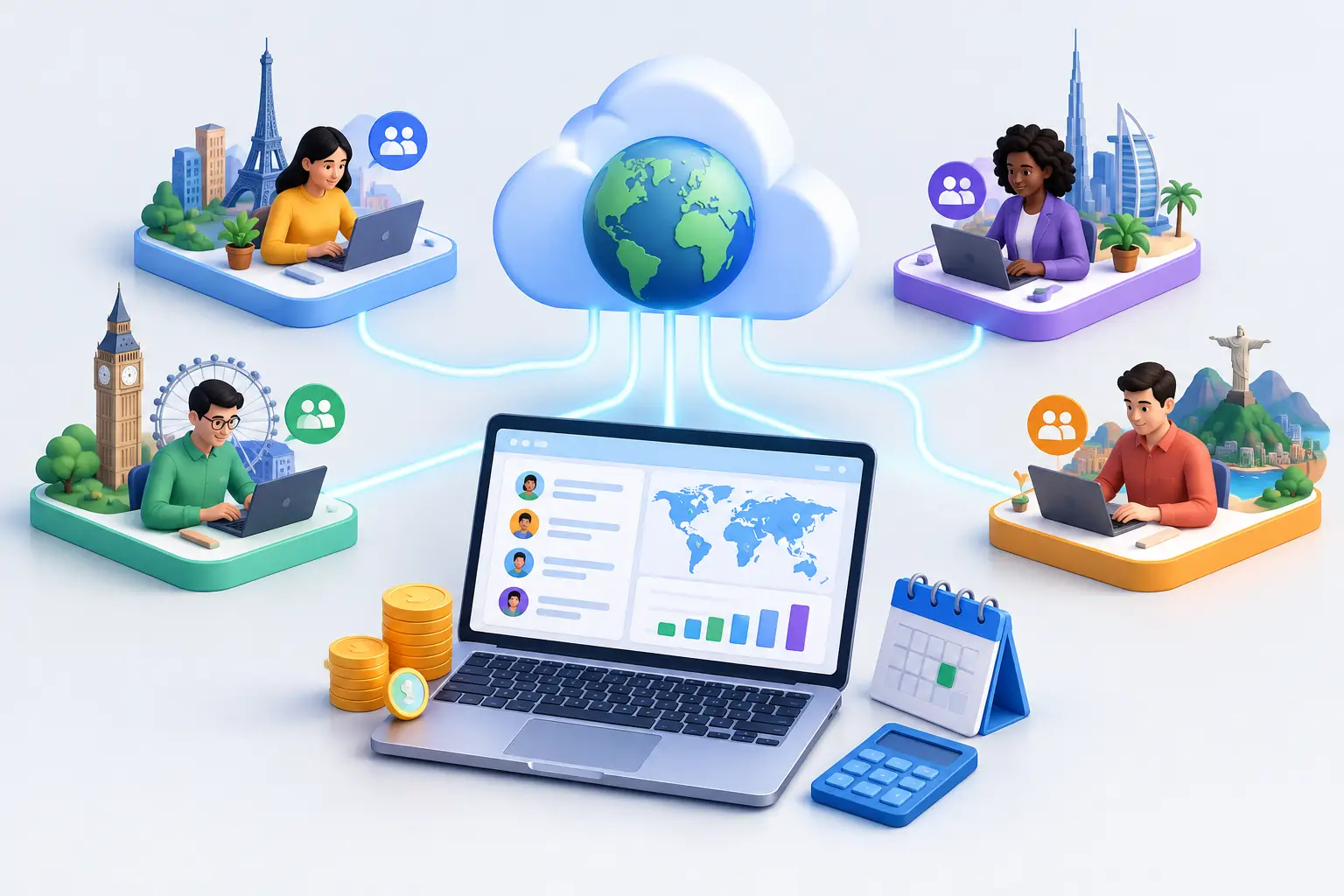
Payroll software evaluations often start with a feature checklist and end with an unpleasant discovery: the selected platform can calculate pay, but it cannot reliably connect time, leave, employee changes, approvals, finance data, and local compliance. A useful cloud payroll comparison looks beyond payslip generation. It tests whether the system can operate as controlled infrastructure for a workforce that crosses entities, countries, and regulatory regimes.
For companies operating in Singapore, New Zealand, Hong Kong, Australia, and the wider APAC region, payroll is not a standalone process. It is the financial outcome of workforce data. If the data model is fragmented, each pay run inherits the fragmentation.
What a cloud payroll comparison should measure
The strongest comparison framework separates table-stakes functionality from operating-model capability. Nearly every modern vendor can store employee profiles, run a calculation, and generate a pay statement. The material differences appear when an employee changes location mid-cycle, earns overtime from a shift schedule, receives a new allowance, takes statutory leave, or moves between legal entities.
Start with the question that matters most: where does payroll-critical data originate, and how does it reach gross-to-net calculation? A platform that relies on repeated CSV imports or manual rekeying can work for a stable, single-country population. It becomes a control risk when workforce changes are frequent or payroll spans jurisdictions.
A better architecture uses one shared employee identity and data model across Core HR, time, attendance, leave, scheduling, benefits, compensation, and payroll. When approved changes flow through the same system of record, payroll teams spend less time reconciling inputs and more time reviewing exceptions.
Local compliance must be executable, not documented
A vendor may state that it supports a country without providing native statutory capability. Those are not equivalent claims. Ask whether the platform has a maintained country pack with local tax and social insurance rules, statutory leave treatment, required reporting, year-end processes, and bank-file formats.
For example, a payroll process in Singapore must accommodate local contribution logic and reporting requirements. New Zealand requires its own tax, leave, and filing treatment. A regional provider should show how jurisdiction-specific logic is configured, updated, tested, and released – not simply point to an implementation partner or a manual workaround.
The practical test is change management. When a statutory rate, threshold, or filing requirement changes, who updates the rule? How is that change validated? Can payroll administrators see its effective date and audit history? A credible answer includes versioned country packs, documented release controls, and clear accountability.
Compare the payroll workflow, not only the calculation engine
Gross-to-net accuracy is essential, but it is only one segment of payroll operations. Evaluate the workflow that surrounds it: input collection, validation, approvals, exception resolution, payment preparation, filing, posting, and reporting.
Look for configurable pay calendars, cutoff rules, retroactive calculations, off-cycle runs, proration, earnings and deduction definitions, and clear pay-run statuses. The system should distinguish a draft calculation from an approved run and preserve an audit trail of who changed what, when, and why.
Approval controls deserve particular attention. Finance may need visibility before funds move. HR may need to approve compensation changes. Payroll may need to validate exceptions before finalization. A mature platform supports role-based access control, delegated approvals, and segregation of duties without forcing administrators to manage the process through email.
Time and attendance integration is another dividing line. In organizations with hourly staff, shift differentials, overtime, public holiday rules, and variable schedules, time data cannot be treated as an afterthought. The payroll platform should either include workforce time management or consume approved time through reliable, traceable integrations. Otherwise, the apparent simplicity of cloud payroll shifts complexity into manual reconciliation.
Assess data architecture and integration depth
Cloud deployment does not automatically mean connected data. Some payroll products are hosted applications with a narrow API layer; others are designed as extensible platforms. The difference affects implementation speed, reporting quality, and long-term operating cost.
Ask whether employee and organizational data are shared natively across modules or copied between separate products. Confirm support for REST and GraphQL APIs, webhooks, OAuth2, SAML SSO, SCIM provisioning where relevant, and documented integration patterns. These capabilities matter when payroll must exchange data with ERP, accounting, recruiting, identity, expense, and collaboration systems.
Integration depth should be evaluated by workflow, not connector count. An integration with NetSuite or QuickBooks is valuable if payroll journals can be mapped by entity, cost center, account, and department, then reconciled with enough detail for finance. An integration with Greenhouse is valuable if an approved hire can create the right worker record, legal entity assignment, and onboarding workflow without duplicate data entry.
Reporting follows the same principle. Leaders need more than a payroll register. They need reconciled labor cost, headcount, overtime, absence, compensation, and compliance views based on the same definitions. If analytics requires exporting data from separate HR, time, and payroll tools into a spreadsheet, the organization still lacks a reliable workforce intelligence layer.
Security, AI, and governance belong in the scorecard
Payroll holds some of the most sensitive data in the business. A cloud payroll comparison should therefore include security and governance requirements from the beginning, with HR, IT, finance, and compliance stakeholders aligned on the evaluation criteria.
At minimum, review role-based permissions, entity and regional data controls, encryption practices, SSO, audit logging, retention settings, and data export controls. Multi-country employers should also understand where data is processed, which data can be segmented by region, and how access is governed for centralized versus local payroll teams.
AI capability requires the same discipline. Useful AI can answer policy questions, identify anomalies, prepare workflow actions, and help administrators locate the source of a payroll variance. But a generic assistant with broad access to payroll data creates avoidable exposure.
Prefer governed private AI agents that operate within existing permissions, cite the source data or policy behind an answer, maintain action logs, and require approvals for consequential changes. AI-native does not mean autonomous payroll without controls. It means intelligence is designed into the system architecture rather than added as an ungoverned interface.
Price the operating model, not just the subscription
Per-employee-per-month pricing is easy to compare and easy to overvalue. The larger cost is often operational: implementation services, local configuration, integrations, training, data cleansing, manual reconciliation, compliance support, and the staff time required to keep systems aligned.
Request a scenario-based commercial model. Include current headcount, planned country expansion, additional legal entities, contractors, hourly workers, and likely integration requirements. Clarify whether country coverage is delivered natively, through a partner, or through a separate employer-of-record arrangement. Each model can be appropriate, but they carry different cost structures, data flows, and accountability boundaries.
Also examine the migration path. A company may begin with Core HR and workforce essentials, then add payroll, advanced time management, rewards, or talent capabilities. A composable platform can support this progression without forcing a data migration every time the organization adds a country or operating requirement.
A practical evaluation sequence
Build a cross-functional evaluation team before booking demonstrations. Payroll should test calculations and exception handling; HR should test employee lifecycle changes; finance should test controls, journals, and reporting; IT should test identity, APIs, security, and data governance.
Give each vendor the same realistic scenarios. Ask them to process a new hire after cutoff, an employee transfer between entities, a retroactive salary change, variable overtime, unpaid leave, an off-cycle termination payment, and a statutory update. Require them to show the resulting audit trail, approvals, accounting output, and employee-facing records.
This is where one composable system becomes more than positioning. When the shared data model connects HR, payroll, time, and analytics in real time, the workflow can be demonstrated end to end rather than explained as a collection of integrations. ZingKey is designed around that model, with country-pack payroll, workforce operations, governed AI, and enterprise integration controls on one codebase.
The right platform will not remove the need for payroll expertise. It will give that expertise a controlled system in which to operate – one that keeps local obligations, workforce changes, and financial outputs connected as the business enters its next market.