7 Payroll Discrepancy Causes to Control Now
Payroll discrepancy causes often begin upstream in HR, time, and tax data. Learn how unified controls reduce errors across every pay run with auditability.
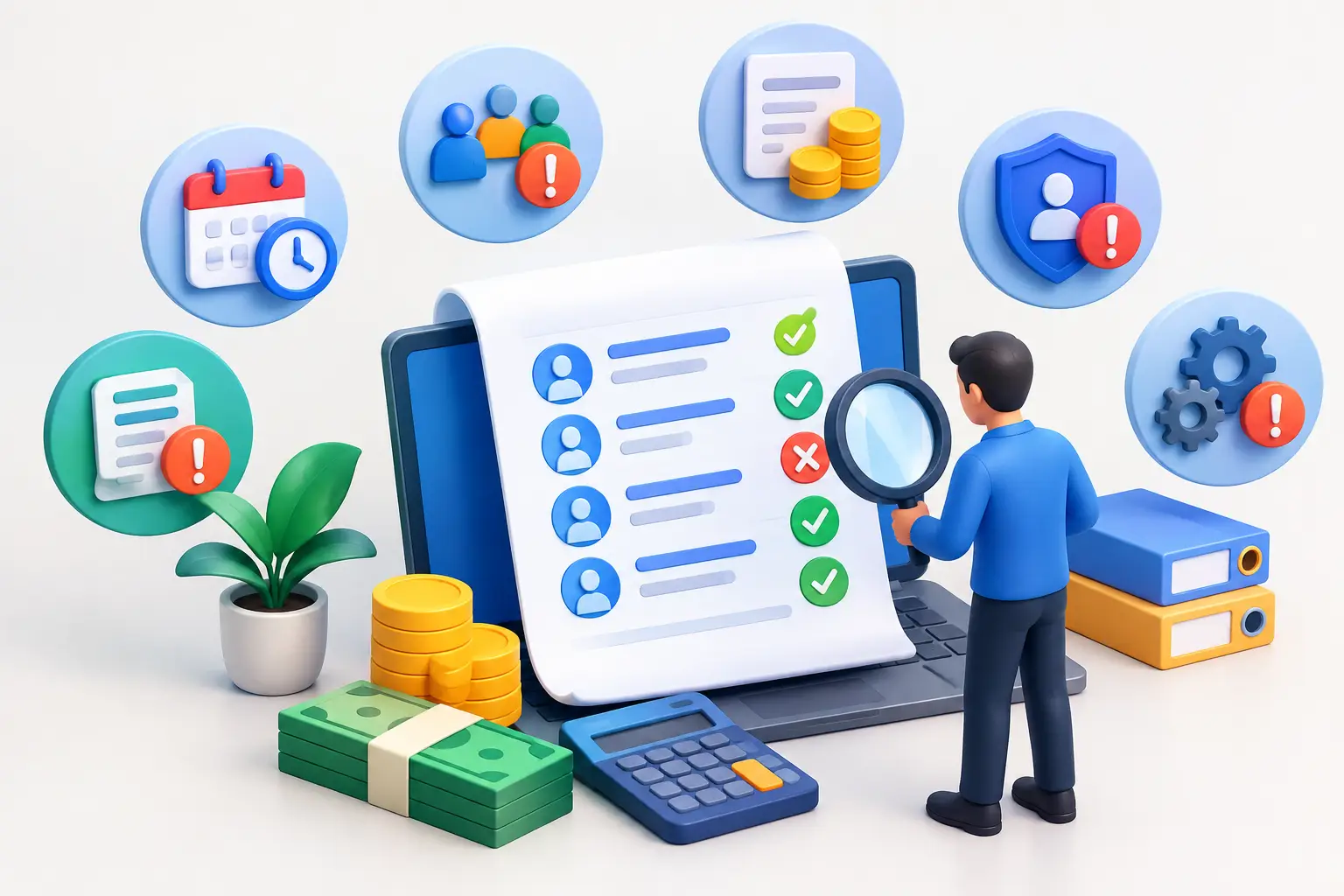
A payroll discrepancy rarely starts in the payroll calculation itself. An employee questions a missing overtime payment, a finance team sees an unexpected payroll variance, or a statutory filing does not reconcile. The visible error appears at payday, but the underlying payroll discrepancy causes often sit upstream: an unapproved schedule change, a delayed employee transfer, a duplicate allowance, or tax data that changed without a controlled effective date.
For companies operating across multiple countries, payroll accuracy is not a final check performed by payroll alone. It is an operating outcome produced by connected HR, time, compensation, benefits, and compliance data. When those systems are fragmented, every handoff creates another opportunity for a discrepancy to enter the pay run.
Why payroll discrepancies are operational signals
A discrepancy is more than a correction ticket. It can indicate that the organization lacks a reliable system of record, that approval paths do not match business reality, or that local rules are being applied from outdated reference data. The consequences extend beyond employee trust. Incorrect gross-to-net calculations can create rework for payroll and finance, delayed bank files, inaccurate labor-cost reporting, and exposure to penalties or employee claims.
The right response depends on the discrepancy. A one-time clerical error requires a different control than recurring overtime variances or a tax withholding issue affecting one legal entity. The objective is not to add more manual review at every step. It is to identify where data loses context, ownership, or traceability, then build controls at that point in the workflow.
The most common payroll discrepancy causes
1. Employee master data is incomplete or changed too late
Payroll depends on accurate employee identity, legal entity, work location, employment type, bank details, tax elections, and compensation terms. If a new hire is entered after the payroll cutoff, or a transfer is recorded in HR but not reflected in payroll, the system may apply the wrong earnings structure or jurisdictional treatment.
Effective dating is especially important. A salary change approved for the next pay period should not overwrite the current rate. Likewise, a location change can affect tax, social insurance, leave, or statutory benefit treatment. Without a shared employee record and clear effective dates, teams often resolve the problem through spreadsheets. That may fix one pay run while leaving the underlying data inconsistency in place.
2. Time, attendance, and overtime inputs do not reconcile
Hourly workforces, shift-based teams, and employees with variable schedules introduce a large volume of pay-affecting events. Missed clock-ins, unapproved timesheets, retroactive shift edits, incorrect break rules, and schedules that do not reflect actual attendance can all produce underpayments or overpayments.
The key question is whether time data moves into payroll as a controlled record or as a periodic export. A file-based handoff may be workable for a small, stable workforce. It becomes fragile when managers update schedules after approvals, employees work across cost centers, or local overtime rules require daily, weekly, or public-holiday logic.
A controlled process should preserve the source event, the approval status, the applicable pay rule, and the calculation result. Payroll teams need to see not only that an employee received 12 overtime hours, but why those hours qualified and who approved the exception.
3. Compensation and benefits changes are managed outside the system of record
Variable pay is a common source of variance. Commissions, bonuses, allowances, equity-related payments, car benefits, expense reimbursements, and deductions can have different taxability and timing rules by country. When compensation teams send one-off files to payroll, version control becomes a material risk.
The issue is not that spreadsheets are inherently inaccurate. The issue is that they do not reliably enforce eligibility, approval, effective date, or calculation logic. A manager may submit a bonus for an employee who changed entities, a recurring allowance may continue after it should end, or a reimbursement may be treated as taxable earnings by mistake.
Compensation events should be governed as structured data, with clear ownership and a record of the policy or agreement that supports the payment. This is particularly valuable for organizations with multiple legal entities, where a benefit that is normal in one country may be handled differently in another.
4. Local tax and statutory rules are outdated or misconfigured
Multi-country payroll introduces rule complexity that cannot be handled safely through generic calculation logic. Tax thresholds, social insurance rates, levy rules, filing requirements, and year-end reporting obligations change. A configuration that was correct at implementation can become incorrect as legislation or an employee’s circumstances change.
Country-specific payroll capabilities should apply current statutory logic and produce the required local outputs, including compliant filings and bank-file formats where applicable. Yet software alone is not enough. Teams still need a defined owner for monitoring rule changes, reviewing exceptions, and validating that new country or entity setups use the correct jurisdictional configuration.
This is where country packs provide an advantage over manually maintained formulas. They concentrate jurisdiction-specific logic in a controlled layer rather than distributing it across local workbooks and individual payroll specialists’ personal knowledge.
5. Integrations duplicate, overwrite, or drop pay-affecting data
An integration can make payroll faster, but only if the data contract is explicit. HR, time, recruiting, benefits, finance, and identity systems may all send updates about the same employee. Without a clear source of truth, duplicate records and conflicting updates are predictable outcomes.
For example, a new hire may be created from a recruiting system, updated by HR during onboarding, and provisioned by an identity platform. If the legal entity or start date differs between systems, payroll may receive whichever update arrived last. Similarly, an API integration that does not support idempotency or error handling can create duplicate variable-pay entries after a retry.
IT and payroll should jointly define field ownership, synchronization frequency, failure alerts, and reconciliation rules. APIs, webhooks, and integration logs are operational controls, not just technical features. They allow teams to identify whether a discrepancy originated in the source system, during transmission, or in payroll processing.
6. Approval workflows do not match payroll cutoffs
Approval is often treated as a simple yes-or-no action. In payroll operations, timing is part of the control. A manager may approve a timesheet after the cutoff, a compensation change may be approved with no effective date, or an exception may bypass review because the approver is on leave.
Well-designed workflows make the deadline visible and distinguish between changes that affect the current pay run and those that must be processed as retroactive adjustments. They also route approvals according to role, entity, location, and payment type. A payroll administrator should not need to infer whether an executive bonus has finance approval or whether an overtime exception complies with local policy.
Role-based access controls matter here. The people who can enter, approve, alter, and release payroll data should not have unrestricted overlapping permissions. Segregation of duties reduces both accidental changes and the risk of unreviewed exceptions.
7. Retroactive adjustments are not traceable
Retro pay is sometimes unavoidable. An employee may receive a backdated promotion, a collective agreement may change a rate, or a correction may be needed after a prior pay run. The risk arises when the adjustment is processed as a lump sum with no clear reference to the original period, source event, or calculation method.
A traceable retro process identifies what changed, when it became effective, which prior periods were affected, and how the delta was calculated. That evidence is essential when employees ask for an explanation, finance needs to reconcile variances, or auditors review payroll controls. It also prevents the same correction from being processed twice.
How to prevent payroll discrepancies before the pay run
Prevention starts by treating payroll as the downstream consumer of workforce operations, not as an isolated monthly task. Establish one authoritative employee record, then connect time, scheduling, compensation, leave, benefits, and organizational data through governed workflows. Each pay-affecting change should carry an effective date, owner, approval status, and audit trail.
Before payroll is finalized, use exception-based review rather than trying to inspect every line item manually. Compare current payroll against prior periods and flag material changes in net pay, gross pay, overtime, deductions, headcount, bank details, and cost-center allocations. Thresholds should vary by workforce and country. A small variance may matter for hourly pay, while a percentage-based threshold may be more practical for salaried populations.
A payroll control framework should also reconcile four records: the approved workforce changes, the time and attendance results, the payroll register, and the funding or bank-file total. When these reconcile consistently, teams can focus attention on genuine exceptions instead of performing repetitive spreadsheet checks.
Build payroll on connected workforce data
The most durable way to reduce payroll discrepancy causes is to remove the gaps between the systems that create pay. A shared data model means an approved employee transfer, schedule update, compensation change, or leave event is available to the right workflow without rekeying or file chasing. Audit logs preserve what changed, who changed it, and when. RBAC keeps sensitive payroll actions controlled.
ZingKey is designed around this operating model: one composable system that connects Core HR, time management, multi-country payroll, rewards, and workforce intelligence through a common identity and data layer. For payroll teams, that architecture turns reconciliation from a monthly recovery exercise into a controlled, visible process.
Employees do not experience payroll as a technical workflow. They experience it as proof that the company keeps its commitments. Build the controls upstream, and payday becomes one of the clearest signals that your workforce operations are working as intended.