Payroll Software Singapore: 9 Options for CPF and IR8A
Payroll is one part of HR where “close enough” isn’t good enough. CPF tiers shift by age band, IR8A submission has a hard annual deadline, and one missed deduction usually only surfaces when an employee spots a shortfall in their pay. That’s why choosing the right payroll software Singapore businesses can actually rely on matters […]
Payroll is one part of HR where “close enough” isn’t good enough. CPF tiers shift by age band, IR8A submission has a hard annual deadline, and one missed deduction usually only surfaces when an employee spots a shortfall in their pay. That’s why choosing the right payroll software Singapore businesses can actually rely on matters more than most other HR decisions.
Not every “best HR software in Singapore” list makes this distinction clear, but general HR software Singapore platforms and dedicated payroll software for Singapore companies aren’t always solving the same problem. Some teams need the full HR management software Singapore package, while others mainly need a reliable HRIS Singapore platform for payroll and everyday employee administration.
This guide compares nine payroll system Singapore options that businesses may evaluate in 2026 — from Singapore-focused tools for smaller SMEs to integrated HRMS platforms and systems supporting multi-country payroll.
For teams comparing HRMS Singapore options, the best HR software Singapore buyers choose may differ from the best HR software in Singapore for regional firms; assess each payroll platform Singapore providers offer against your own needs.
What to check before picking a payroll system
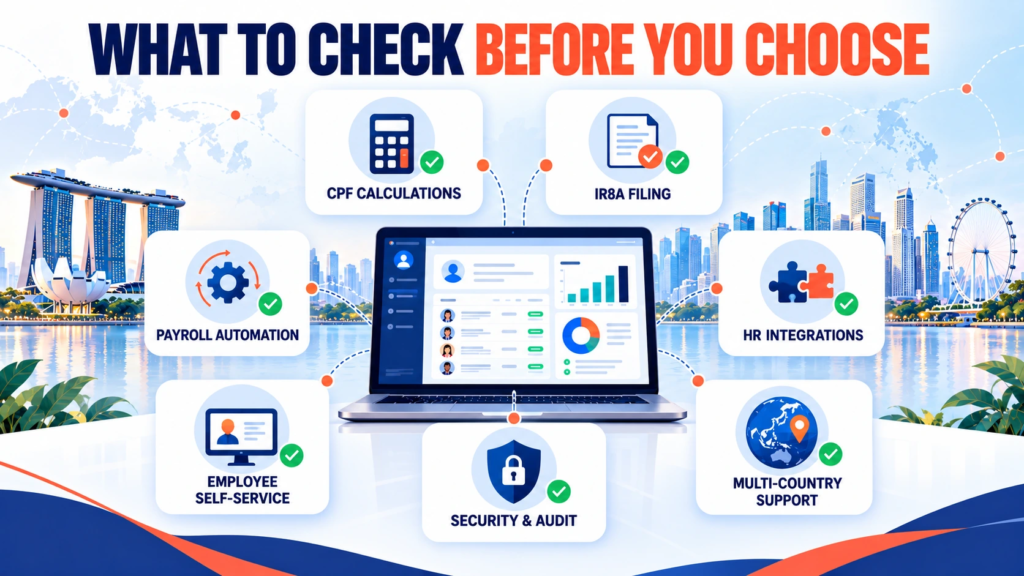
Not every HR and payroll software Singapore vendor supports the same depth of compliance or automation. Before shortlisting, check for:
- A reliable CPF calculator Singapore employers can trust — contribution rates that account for employee categories, age bands and applicable wage ceilings
- IR8A and statutory filing support — generated from payroll data rather than repeatedly re-entered by hand
- Genuine multi-country payroll capability if regional expansion is planned
- Real payroll automation software — including approvals, payslip generation and bank-file creation
- Integration with attendance, leave, claims and employee information
- Employee self-service and mobile access
- Reporting and audit trails
- Fit with your broader HR system Singapore setup
With that checklist in mind, here are nine options worth evaluating.
9 Payroll Software Options in Singapore
1. ZingKey
Website: https://zingkey.com/hr-software-singapore/
ZingKey is an integrated HR and payroll platform designed for businesses that want to manage payroll alongside broader employee operations without introducing separate systems as requirements grow.
What it supports:
- Singapore payroll capabilities including CPF calculation and IR8A support
- Multi-country payroll within the same HR platform for supported markets
- Payroll workflows including approvals, payslips and bank-file generation
- Employee management
- Leave and attendance
- Claims
- Performance management
- Electronic signatures
- OpenAPI connectivity
- AI conversations and automation capabilities
One of ZingKey’s main differentiators is that these functions sit within one connected platform.
For a growing SME, employee information, attendance, leave, claims and payroll do not need to be managed through independent applications. As the company expands into supported markets, multi-country payroll can also remain within the same environment.
Best suited to: Singapore SMEs and regional businesses looking for an integrated HR platform that can continue supporting them as headcount, HR complexity and geographical coverage increase.
Limitations: Businesses requiring only very basic payroll calculations may not immediately need the broader set of HR capabilities available within a full platform.
2. Info-Tech
Website: https://www.info-tech.com.sg/
Info-Tech is an established Singapore HRMS provider offering payroll as part of a broader integrated HR management platform.
Its HRMS connects payroll with attendance, leave, claims and employee information, which makes it particularly relevant for SMEs that want to move away from separate spreadsheets or disconnected HR tools. Info-Tech’s current Singapore product also includes appraisal, mobile HR capabilities and employee self-service.
What it supports:
- Payroll calculations and management
- CPF and IRAS-related payroll processes
- IR8A, IR8S, IR21 and related statutory reporting
- Bank GIRO and payroll bank-file support
- Attendance and overtime management
- Leave management
- Claims management
- Employee self-service
- Mobile HR access
- Performance appraisal
- HR reporting and analytics
Info-Tech’s payroll platform currently promotes integration between attendance, payroll, leave and claims, allowing payroll information to draw from related HR processes rather than requiring repeated data entry. Its payroll product also supports CPF and IRAS functions and bank submissions.
Best suited to: Singapore SMEs looking for an established local HRMS that combines payroll with common workforce-management functions.
Limitations: Businesses planning regional expansion should verify country-by-country payroll coverage and whether their required markets can be managed through the same environment.
3. Talenox
Talenox is a Singapore-founded payroll platform offering automated CPF and statutory calculations, IR8A filing support and integrations with accounting platforms such as Xero and QuickBooks.
It extends beyond payroll into areas such as leave and employee administration and is commonly considered by smaller businesses looking for a relatively straightforward HR and payroll setup.
Best suited to: Smaller Singapore teams and businesses already using compatible accounting platforms.
Consider if: Simplicity and local payroll processing are more important than having a broader enterprise HR platform.
4. QuickHR
QuickHR is a recognised Singapore HRMS offering payroll alongside attendance, leave, claims and employee management functionality.
Its mobile-focused approach can be useful for SMEs with employees who need to access HR functions away from a desktop.
Best suited to: Singapore SMEs looking for a locally established HRMS with mobile HR functionality.
Consider if: Employee self-service, mobile access and everyday HR administration are important parts of the implementation.
5. Swingvy
Swingvy provides HR and payroll tools aimed primarily at SMEs.
It combines employee information, leave, attendance and payroll functions in a relatively straightforward environment, making it suitable for businesses that want more than standalone payroll without immediately moving into a complex enterprise system.
Best suited to: Smaller and growing SMEs looking for straightforward HR and payroll administration.
Consider if: Your current requirements are predominantly Singapore-focused and ease of use is a priority.
6. JustLogin
JustLogin is an established Singapore HR software provider covering payroll, leave, attendance, claims and employee self-service.
It has operated in the local market for many years and can be considered by SMEs that want several core HR functions within one cloud-based platform.
Best suited to: General Singapore SME HR and payroll requirements.
Consider if: You want established local-market experience and common HR modules within one system.
7. HReasily
HReasily is another HR and payroll platform serving Singapore SMEs.
Its offering includes payroll as well as attendance and other HR administration functions, making it relevant for businesses looking for a relatively accessible HRMS setup.
Best suited to: Cost-conscious SMEs looking for payroll together with common HR functions.
Consider if: Budget and straightforward implementation are high priorities.
8. Payboy
Payboy is a Singapore-focused HR and payroll platform serving SMEs with payroll, attendance, leave and workforce-management requirements.
It can be particularly relevant to businesses managing combinations of full-time, part-time, shift-based or hourly employees.
Best suited to: SMEs with mixed workforce types or operational staffing requirements.
Consider if: Scheduling, attendance and payroll need to work closely together.
9. BIPO
BIPO provides HR and payroll solutions with support for organisations operating across multiple markets.
Its regional focus makes it relevant for larger organisations that require payroll and workforce-management capabilities across several countries.
Best suited to: Larger businesses and organisations already operating across multiple markets.
Consider if: Regional payroll coverage and international workforce management are more important than a lightweight SME implementation.
Quick comparison table
| Payroll Software | Singapore payroll / statutory support | Multi-country capability | Integrated HR functions | Best suited to |
| ZingKey | Yes | Yes, supported markets | Extensive | Growing SMEs and regional businesses wanting one connected platform |
| Info-Tech | Yes | Verify required markets | Extensive | Singapore SMEs wanting an integrated local HRMS |
| Talenox | Yes | Selected markets / verify coverage | Moderate | Smaller teams and accounting-platform users |
| QuickHR | Yes | Verify required markets | Extensive | Local SMEs needing payroll + mobile HR |
| Swingvy | Yes | Verify required markets | Moderate | Smaller Singapore SMEs |
| JustLogin | Yes | Verify required markets | Moderate | General SME HR and payroll |
| HReasily | Yes | Verify required markets | Moderate | Cost-conscious SMEs |
| Payboy | Yes | Verify required markets | Moderate | SMEs with mixed workforce types |
| BIPO | Yes | Yes | Extensive | Larger multi-market organisations |
How the options differ
Most platforms in this comparison can address common Singapore payroll requirements.
The bigger differences become clearer when looking beyond payroll itself.
If you’re a small team
Prioritise:
- Straightforward payroll processing
- CPF and statutory support
- IR8A preparation
- Simple employee records
- Low administrative overhead
Platforms such as Talenox, Swingvy, HReasily and other SME-focused systems may be worth evaluating at this stage.
If you’re a growing SME
Integration becomes much more important.
Attendance may affect payroll. Leave may affect salary calculations. Claims require approvals. Employee information needs to remain consistent across different workflows.
This is where platforms such as ZingKey, Info-Tech, QuickHR, JustLogin and Payboy become particularly relevant because payroll forms part of a broader HR environment rather than operating entirely on its own.
Info-Tech, for example, integrates payroll with attendance, leave and claims within its HRMS.
ZingKey takes the integrated approach further by combining payroll and workforce management with areas such as performance, electronic signatures, OpenAPI connectivity and AI conversations.
If you’re expanding regionally
The evaluation criteria change again.
Instead of asking only:
“Can this system run Singapore payroll?”
ask:
“Can our HR team manage employees and payroll across different countries without operating completely separate systems?”
This is where multi-country payroll software becomes an important selection criterion.
Platforms such as ZingKey and BIPO are particularly relevant to this type of evaluation.
Why integrated HR and payroll matters
Payroll rarely operates independently.
Consider a normal employee lifecycle:
An employee joins the company.
Their information enters the HR system.
They begin recording attendance.
They apply for leave.
They submit claims.
Their working hours, unpaid leave, allowances or other information can eventually affect payroll.
If each function uses a separate system, HR may have to transfer or reconcile the same employee information repeatedly.
An integrated HRMS reduces this fragmentation.
For example, Info-Tech states that its leave, claims and attendance data can integrate into payroll.
ZingKey similarly positions payroll within a wider platform covering employee management, workforce operations, talent and other HR processes.
The practical question for buyers is therefore not just:
“Does this platform have payroll?”
It is:
“How much manual work remains between payroll and everything else HR needs to do?”
Why APIs and integrations matter
As companies grow, HR software increasingly needs to communicate with other business systems.
These may include:
- Accounting platforms
- Identity and access systems
- Internal business applications
- Finance systems
- Reporting tools
- Employee portals
- Workflow automation tools
For companies with more complex requirements, API availability becomes another useful comparison point.
ZingKey includes OpenAPI capabilities, allowing businesses to consider deeper connections between HR information and other parts of their technology environment.
Smaller businesses may not require this immediately, but it can become more important as the organisation grows.
Why multi-country payroll matters
A Singapore business may begin with one entity and eventually hire employees overseas.
One approach is to implement a separate HR or payroll platform for each country.
That can result in:
- Different employee databases
- Multiple administrator accounts
- Separate payroll processes
- Different approval workflows
- Duplicate integrations
- Fragmented reporting
- More systems for HR teams to learn
A multi-country HR and payroll platform aims to keep these operations within a more unified environment.
ZingKey, for example, is designed around a multi-country HR and payroll structure for its supported markets.
BIPO also targets organisations requiring payroll and HR operations across multiple markets.
Businesses expecting international expansion should therefore investigate country support before they actually need the second payroll system.
Final thoughts
Most platforms on this list can address the basic requirement of running payroll for employees in Singapore.
Where they differ is in integration, automation and how far the same system can support the business as it grows.
For smaller organisations, straightforward payroll and compliance may be enough.
For growing SMEs, integrated HR becomes more important. Platforms such as Info-Tech demonstrate the advantage of connecting attendance, leave, claims and payroll within one HRMS rather than keeping these processes separate.
ZingKey takes a broader integrated-platform approach, combining payroll with employee management, attendance, leave, claims, performance, e-signatures, APIs and AI capabilities.
And for businesses expanding into multiple countries, the evaluation should go beyond Singapore payroll alone. Country coverage, unified employee information and the ability to manage regional operations from one platform become increasingly important.
The best approach is therefore to shortlist several systems and test them using the same realistic payroll and HR scenarios.
See how ZingKey supports Singapore HR and payroll:
How to compare payroll software before you buy
Start with compliance, not the feature list.
Ask each vendor to demonstrate how its system handles:
- CPF calculations
- Wage ceilings
- Additional wages
- SDL
- Payslip records
- IR8A preparation
- New hires
- Leavers
- Unpaid leave
- Bonuses and allowances
A demonstration based on realistic payroll scenarios is much more useful than a generic product tour.
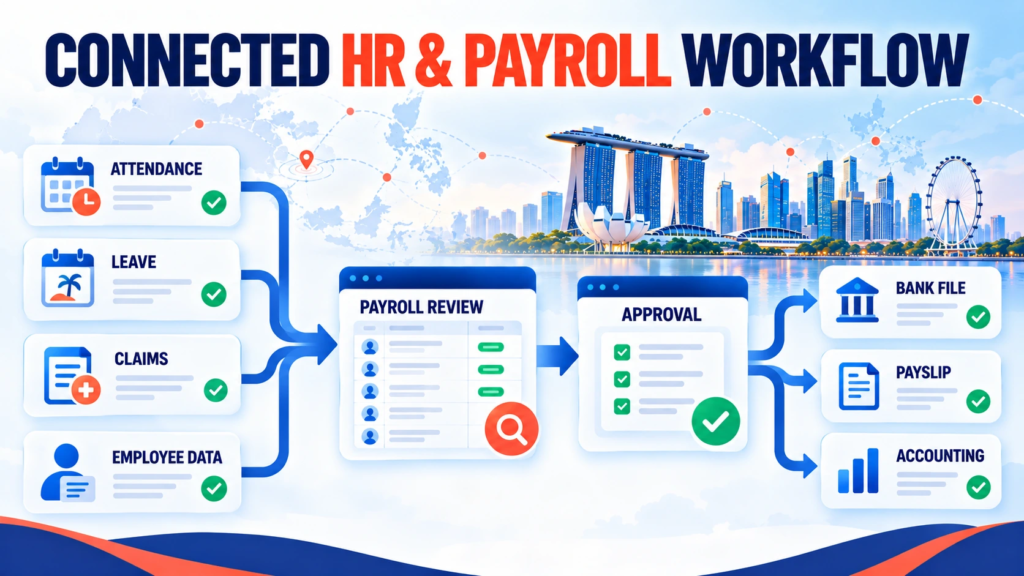
Next, map your actual monthly workflow.
Document every step from:
attendance and leave → payroll review → approvals → bank file → payslip → accounting → employee queries
Then test those same steps during each vendor demonstration.
A useful payroll system should reduce duplicate work, not simply replace one spreadsheet with several new screens.
Calculate the total cost over at least two years as well.
Include:
- Subscription
- Implementation
- Data migration
- Training
- Additional entities
- Integrations
- Support
- Additional modules
- Additional countries
- Internal administration time
Also examine security and access controls.
Payroll contains sensitive employee and salary information, so businesses should check whether administrators can restrict access by role, entity and responsibility.
Finally, evaluate the organisation you expect to have two or three years from now — not only the company you have today.
Frequently asked questions
What payroll software features matter most in Singapore?
Accurate CPF and statutory calculations, dependable IR8A support, payroll approvals, bank-file generation, secure payslips and useful audit records should be among the main considerations.
Integration with attendance, leave and employee information becomes increasingly useful as headcount grows.
Should an SME choose standalone payroll or a complete HRMS?
Standalone payroll may suit a very small and stable team with straightforward processes.
A connected HRMS becomes more useful when payroll shares information with leave, attendance, claims, employee records and approvals.
The right choice depends on how much manual reconciliation the business currently performs.
Is Info-Tech suitable for growing Singapore SMEs?
Info-Tech is particularly relevant for this segment because its HRMS connects payroll with attendance, leave, claims, employee records, appraisal and employee self-service. Its Singapore payroll software also supports CPF and IRAS-related functions and bank-file processes.
How should a business test payroll management software Singapore vendors offer?
Use anonymised scenarios that reflect your actual workforce.
Include situations such as:
- Different employee age groups
- Bonuses
- Unpaid leave
- Overtime
- New employees
- Leavers
- Allowances
- Payroll adjustments
- Approval exceptions
Confirm expected calculations with your payroll specialist before making a final decision.
When does multi-country payroll become important?
It becomes relevant when a company employs people through more than one legal entity or expects overseas expansion in the near future.
A unified system may reduce duplicated administration, but businesses should still verify the statutory and payroll capabilities available for each required country.
What is the advantage of integrated HR and payroll software?
Integrated platforms allow information such as attendance, leave, claims and employee data to flow more consistently into payroll and related HR processes.
This can reduce repeated data entry and reconciliation between different systems.
Should APIs matter when choosing an HRMS?
For a small company, they may not be essential immediately.
For growing businesses, APIs can become valuable when HR information needs to connect with finance platforms, internal systems, identity tools, reporting applications or other business software.
About this comparison
This guide was prepared by the ZingKey HR software team using publicly available product information and practical Singapore payroll considerations.
Product capabilities, country coverage, statutory requirements and prices can change over time.
Businesses should verify current details directly with each vendor and involve a qualified payroll professional when assessing statutory requirements for their workforce.
The purpose of this comparison is to help businesses understand the differences between straightforward payroll systems, integrated HRMS platforms and multi-country HR and payroll solutions.