Best HR & Payroll Software Singapore by Company Size
Many best HR software in Singapore lists rank every platform the same way, whether you’re a 10-person startup or a 300-person company with multiple entities. But the right choice usually depends less on which platform is best overall and more on your stage of growth. A tool that works for a lean 15-person team can […]
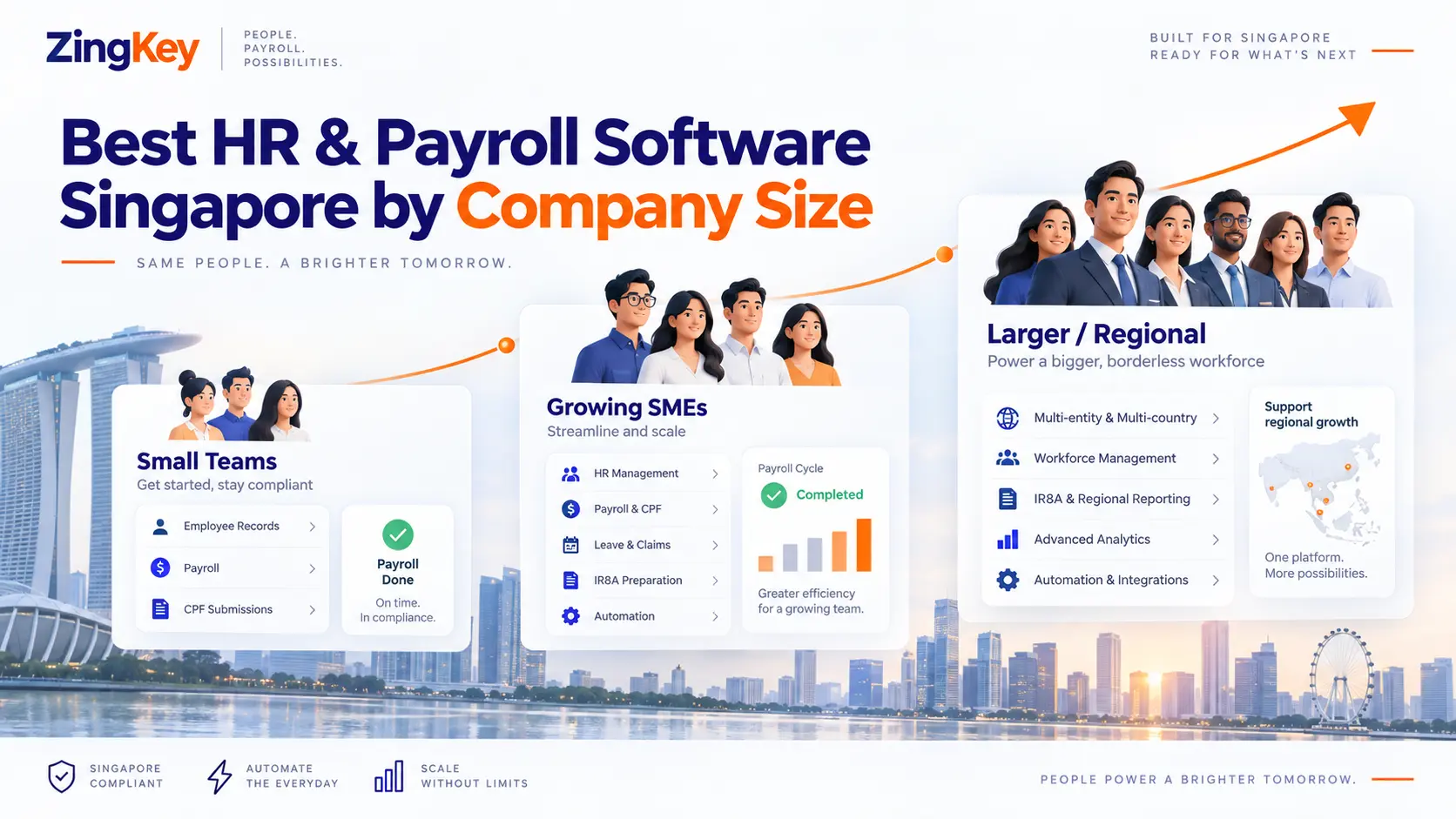
Many best HR software in Singapore lists rank every platform the same way, whether you’re a 10-person startup or a 300-person company with multiple entities.
But the right choice usually depends less on which platform is best overall and more on your stage of growth. A tool that works for a lean 15-person team can feel outgrown within two years, while a platform built for enterprise scale can add extra work for a small team that is just trying to manage payroll and CPF correctly.
This is why many teams look for HR management software Singapore companies can use, HRIS Singapore options, or payroll software for Singapore companies that match current needs and future plans.
Here’s what to look for at each stage, along with HR and payroll software options that may fit, plus one platform built to support companies as they grow.
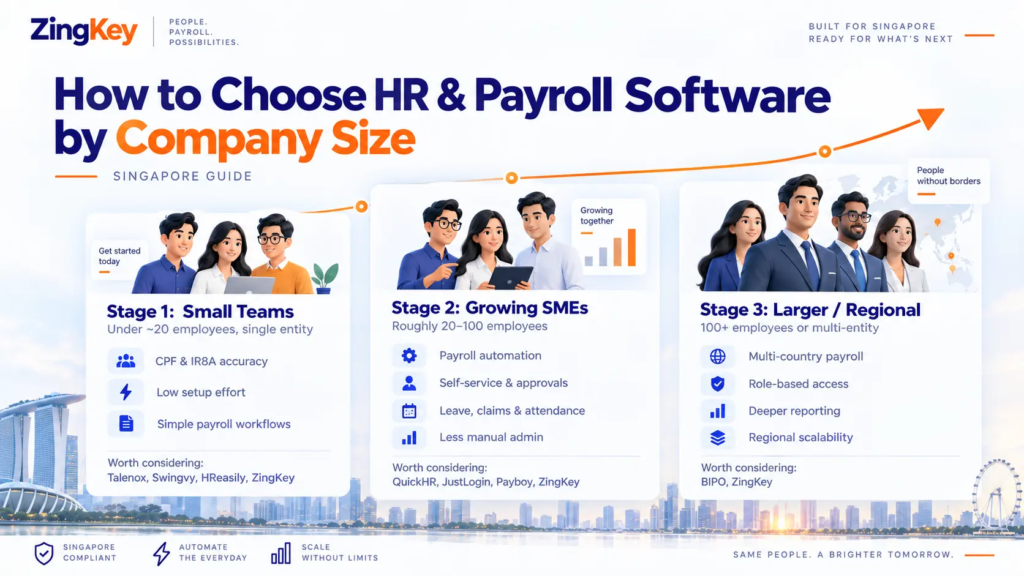
Stage 1: Small teams (under 20 employees, single entity)
At this size, the priority is simple: accurate CPF and IR8A support, low setup effort, and a system that does not need a dedicated HR hire to run it.
You probably do not need complex workflow automation or multi-country payroll yet. You need payroll software Singapore businesses can use, or a payroll system Singapore teams can trust, without adding more admin work. Some teams also compare CPF calculator Singapore tools at this stage, but the main need is correct payroll and clean records.
Worth considering
• Talenox — a popular option among smaller Singapore businesses, with payroll, leave and HR functions designed for day-to-day admin.
• Swingvy — provides HR, payroll, leave and employee management tools in a straightforward system for smaller teams.
• HReasily — offers payroll and HR functions for SMEs, with support for common Singapore payroll needs and IR8A submission.
• ZingKey — also fits well at this stage, giving smaller companies core HR, leave, attendance and payroll features without forcing them into a complex enterprise setup.
For a small business, the key question is usually not how many features a platform has. It is whether payroll can be processed accurately, employee records stay organised, and everyday HR tasks can be handled without extra effort.
Stage 2: Growing SMEs (roughly 20-100 employees, still single entity)
This is usually where gaps start to show.
Manual leave approvals, disconnected spreadsheets, separate HR tools and repetitive admin work stop scaling. As headcount grows, businesses need more than basic payroll processing. They need an integrated HR system Singapore teams can use to connect everyday HR work in one place.
At this point, many teams start comparing payroll automation software and full HRMS options.
Payroll, employee records, attendance, leave, claims, approvals and other processes increasingly affect one another. When these functions sit in different systems, HR teams often spend more time transferring information and checking whether records match.
Worth considering
• ZingKey — designed as an integrated HR solution covering payroll, employee management, leave, attendance, claims, performance and broader HR operations within one platform. It also includes electronic signatures, OpenAPI connections and AI chat, allowing companies to connect more parts of their HR workflow instead of relying on separate systems.
For growing SMEs, this integrated approach means employee information, HR processes and payroll can remain connected as the company expands. It can reduce duplicate admin work while giving HR teams a more consistent view of workforce information.
• Info-Tech — an established HRMS Singapore option for Singapore businesses, covering common HR functions such as payroll, attendance, leave, claims and employee management within one system.
• QuickHR — a recognised HR platform for Singapore SMEs with payroll, leave, attendance and mobile HR functions.
• JustLogin — an established HR and payroll software Singapore platform offering integrated payroll, leave, attendance, claims and employee self-service functions.
• Payboy — a practical option for SMEs managing payroll, leave, attendance and workforces that may include both full-time and part-time employees.
At this stage, integration becomes increasingly important.
Instead of simply asking whether the software can calculate payroll, businesses should consider whether employee records, attendance, leave, approvals, documents, claims and payroll information can work together without HR repeatedly updating different systems. Many companies also start comparing payroll management software Singapore buyers can trust for day-to-day work, not just for pay runs.
Stage 3: Larger or multi-entity businesses (100+ employees, or expanding beyond Singapore)
At this stage, the requirements change significantly.
Companies may be managing multiple entities, larger HR teams, different approval structures or employees across several countries.
This is where multi-country payroll software becomes more important.
Rather than maintaining one HR or payroll system for Singapore and separate systems for every additional country, businesses may prefer a platform where regional workforce information can be managed within one environment. A payroll platform Singapore teams can scale with is often easier to run than a patchwork of separate tools.
Worth considering
• ZingKey — particularly relevant for companies expanding across multiple countries because its multi-country payroll capabilities sit within the same platform used for employee management, attendance, leave and other HR operations.
This allows HR teams to manage employees across supported countries from one unified system, rather than switching between different country-specific HR or payroll platforms.
Employee information, attendance, leave and payroll calculations for multiple countries can be managed within the same environment, giving regional HR teams a more consistent way to operate across different entities and markets.
For businesses expanding internationally, this can reduce duplicated employee records, fragmented workflows and the effort of maintaining multiple HR systems for different countries.
• BIPO — another option for larger organisations requiring regional HR and multi-country payroll capabilities across several markets.
For businesses at this stage, the question is no longer simply whether a system can process payroll.
The bigger consideration is whether HR teams can manage employees, workforce processes and payroll across multiple locations without creating a patchwork of country-specific systems.
Quick self-check
| Stage | Headcount / structure | Priority | Risk of outgrowing |
| Small | Under 20, single entity | CPF and IR8A support, simple setup | Low, although changing systems later can be disruptive |
| Growing SME | 20-100, single entity | Integrated HR operations, payroll automation and employee self-service | Medium — fragmented admin often becomes the first problem |
| Larger / regional | 100+, multi-entity or multi-country | Multi-country payroll, centralised HR management and access controls | High if relying on separate single-market systems |
The platform that works across different stages: ZingKey
A common challenge with HR software is that the system a business starts with may not be the system it needs several years later.
A platform suitable for 15 employees may become restrictive at 100 employees. A Singapore-only payroll tool may also become more difficult to maintain when a business starts hiring employees in another country.
ZingKey is designed to support businesses across these different stages.
For smaller teams
Businesses can begin with essential HR capabilities such as employee management, leave, attendance and payroll without immediately introducing unnecessary complexity.
For growing SMEs
As HR requirements increase, the same platform can support a broader range of operations including:
• Payroll
• Leave
• Attendance
• Claims
• Performance management
• Employee management
• Electronic signatures
• OpenAPI connections
• AI chat
Instead of adding separate tools as the company grows, these functions can remain connected within the same HR environment.
For larger and regional businesses
ZingKey’s multi-country payroll capabilities allow businesses to manage employees and payroll across supported markets from one system.
HR teams can maintain employee information, attendance, leave and payroll calculations within the same platform rather than operating different systems for each country.
This creates a more consistent HR structure as the organisation grows across entities and markets.
Website:
++https://zingkey.com/hr-software-singapore/++
Why integration matters as a company grows
Many HR software comparisons focus on individual features.
But the number of features matters less if those features operate separately.
For example, an employee taking unpaid leave can affect attendance records, payroll calculations and employee documentation. If leave, attendance and payroll are managed separately, HR may need to update the same information several times.
An integrated HR platform can reduce this fragmentation by keeping related processes connected.
This becomes increasingly valuable as a company grows because the volume of employee changes, approvals and payroll transactions increases with headcount.
Why multi-country capability matters
Multi-country expansion introduces another layer of complexity.
A company may begin with employees only in Singapore, then establish another entity or hire employees elsewhere.
One approach is to implement a different HR or payroll system for every market.
But that can create:
• Separate employee databases
• Different workflows for each country
• Multiple administrator logins
• Duplicate reporting processes
• More integrations to maintain
• Additional training for HR teams
• Greater difficulty obtaining a regional workforce view
A unified multi-country HR and payroll platform takes a different approach.
Instead of separating each country into an entirely different system, employee management and payroll operations can remain within a common platform while supporting the requirements of each supported market.
For organisations expecting regional growth, this is worth considering before selecting a system that only solves today’s requirements.
Final thoughts
There is no single best HR software Singapore businesses should automatically choose.
The right platform depends on company size, HR complexity, existing processes and future expansion plans.
For a small company, simplicity and reliable payroll support may matter most.
For a growing SME, the priority usually shifts toward integrated HR operations, employee self-service and reducing manual administration.
For larger or regional organisations, centralised employee management and multi-country payroll software become increasingly important.
The key is therefore not simply choosing the platform with the longest feature list.
It is choosing a system that fits where the business is today while considering what the organisation may need in the next two or three years.
ZingKey is designed around this progression — starting with essential HR functions, expanding into integrated HR operations, and supporting multi-country workforce and payroll management as organisations grow.
++See how ZingKey supports Singapore businesses at every stage++
Frequently asked questions
What payroll features matter most for a small Singapore company?
Accurate payroll calculations, CPF support, IR8A support, secure payslips, bank-file generation and straightforward employee administration are among the important considerations.
Small teams should also favour workflows that are easy to manage without requiring a dedicated HR system administrator.
When should an SME move from payroll software to a full HRMS?
A broader HRMS becomes more useful when payroll, leave, attendance, claims, employee records and approvals are increasingly being managed manually or across several different systems.
As headcount grows, connecting these processes can reduce repeated admin work and provide HR with more consistent employee information.
What should growing SMEs look for in an integrated HR system?
Growing SMEs should look beyond payroll alone.
Useful capabilities may include employee management, attendance, leave, claims, performance management, document workflows, employee self-service, integrations and automation.
Companies should also consider whether the platform provides APIs or other integration options that allow HR information to connect with their wider business systems.
How should a company evaluate payroll automation software?
Use masked scenarios based on real payroll situations and compare the results with figures reviewed by your payroll specialist.
Also evaluate exception handling, approval workflows, reporting, integrations, implementation support and how easily administrators can identify and correct payroll issues.
Do not rely only on a checklist of advertised features.
Is multi-country payroll software necessary before overseas expansion?
Not necessarily, but it is worth considering when overseas expansion is likely within the next few years.
Choosing a platform with multi-country capabilities earlier may reduce the need to migrate employee information or implement another HR system when the company enters a new market.
However, businesses should still verify the exact country coverage and compliance capabilities required for their operations.
What is the advantage of using one HR platform across multiple countries?
A unified platform can reduce the need to maintain separate employee databases and HR systems for each country.
Employee management, attendance, leave and payroll information can be managed from a common environment while country-specific payroll requirements are handled for supported markets.
This can make regional administration, reporting and workforce management more consistent.
Can one HRIS Singapore platform serve both small and large teams?
Some platforms are designed to scale through additional modules, permissions, integrations, workflow controls and multi-entity capabilities.
Businesses should check that the system remains straightforward enough for smaller teams while providing the reporting, automation and regional capabilities required as the organisation grows.
Why are OpenAPI capabilities useful in an HR system?
OpenAPI capabilities can make it easier for organisations to connect their HR platform with other business systems.
Depending on the available integrations and APIs, businesses may connect HR information with finance platforms, internal applications, identity systems or other operational tools instead of relying entirely on manual data transfers.
How can AI chat be used within HR software?
AI chat capabilities can provide another way for employees or HR teams to interact with HR information and workflows.
The exact use cases depend on the platform, but chat interfaces can make certain HR tasks and information easier to access without requiring users to navigate through multiple screens.
About this comparison
This guide was prepared by the ZingKey HR software team using publicly available product information and practical Singapore HR and payroll considerations.
Product capabilities, country coverage, statutory requirements and pricing can change over time. Businesses should verify current details directly with each software provider and consult qualified payroll or HR professionals when assessing requirements for their workforce.
The purpose of this comparison is not simply to identify the platform with the most features, but to help businesses consider which type of HR software Singapore teams need most at their current size, operational complexity and expected growth.
Practical next step
Before attending vendor demonstrations, create a simple weighted scorecard.
Give higher weight to areas that directly affect everyday HR operations, such as:
• Payroll and statutory requirements
• Employee management
• Leave and attendance
• Workflow integration
• Employee self-service
• Reporting
• Security
• Implementation support
• API and integration capabilities
• Multi-entity requirements
• Multi-country payroll requirements
Then shortlist two or three platforms and test the same masked HR and payroll scenarios in each.
Record any manual workaround required.
For companies expecting to grow, also test a future scenario — for example, increasing headcount significantly, creating another entity or adding employees in another country.
This makes it easier to see not only which platform works today, but which system is less likely to create another migration project as the business expands.
Q&A
Question: How should a business decide which HR and payroll software stage it belongs to?
Short answer: Start with headcount and structure, then consider complexity. A company under about 20 employees with one Singapore entity usually needs simple payroll, CPF and IR8A support, and easy administration. A 20-100 employee SME typically needs connected HR operations across leave, attendance, claims, approvals and payroll. A company with 100+ employees, multiple entities or overseas expansion plans should place more emphasis on centralised HR management and multi-country payroll capability.
Question: Why does the guide place so much emphasis on integration rather than feature count?
Short answer: A long feature list is less useful if each function operates separately. As the guide explains, leave, attendance, employee records, claims and payroll often affect one another. If those processes sit in disconnected systems, HR teams may need to re-enter or reconcile information repeatedly. An integrated HR system helps keep related data and workflows connected, which becomes more valuable as headcount and transaction volume increase.
Question: Should a small company choose a system only for its current needs?
Short answer: Not entirely. Small companies should avoid unnecessary complexity, but they should also consider whether the system can support growth over the next two or three years. Changing HR and payroll systems later can be disruptive, especially once employee records, payroll history, approvals and workflows are already established. The guide suggests choosing a platform that fits current needs while reducing the risk of another migration project as the business expands.
Question: What should companies test during vendor demonstrations?
Short answer: Companies should test real-world masked HR and payroll scenarios rather than relying only on product brochures. Useful tests include payroll calculations, CPF and statutory requirements, leave and attendance changes, claims, approvals, reporting, integrations and exception handling. For growing companies, the guide also recommends testing future scenarios such as higher headcount, a new entity or employees in another country.
Question: Why might ZingKey be considered across multiple company sizes?
Short answer: The guide positions ZingKey as a platform designed to support different growth stages. Smaller teams can use core HR, leave, attendance and payroll functions without immediately adopting a complex setup. Growing SMEs can add broader capabilities such as claims, performance management, electronic signatures, OpenAPI connections and AI chat. Larger or regional businesses can use its multi-country payroll capabilities to manage employees and payroll across supported markets from one system.