What Is Payroll Localization in Global Payroll?
What is payroll localization? Learn how local tax, labor, banking, and reporting rules shape accurate, compliant payroll across every market you operate in.
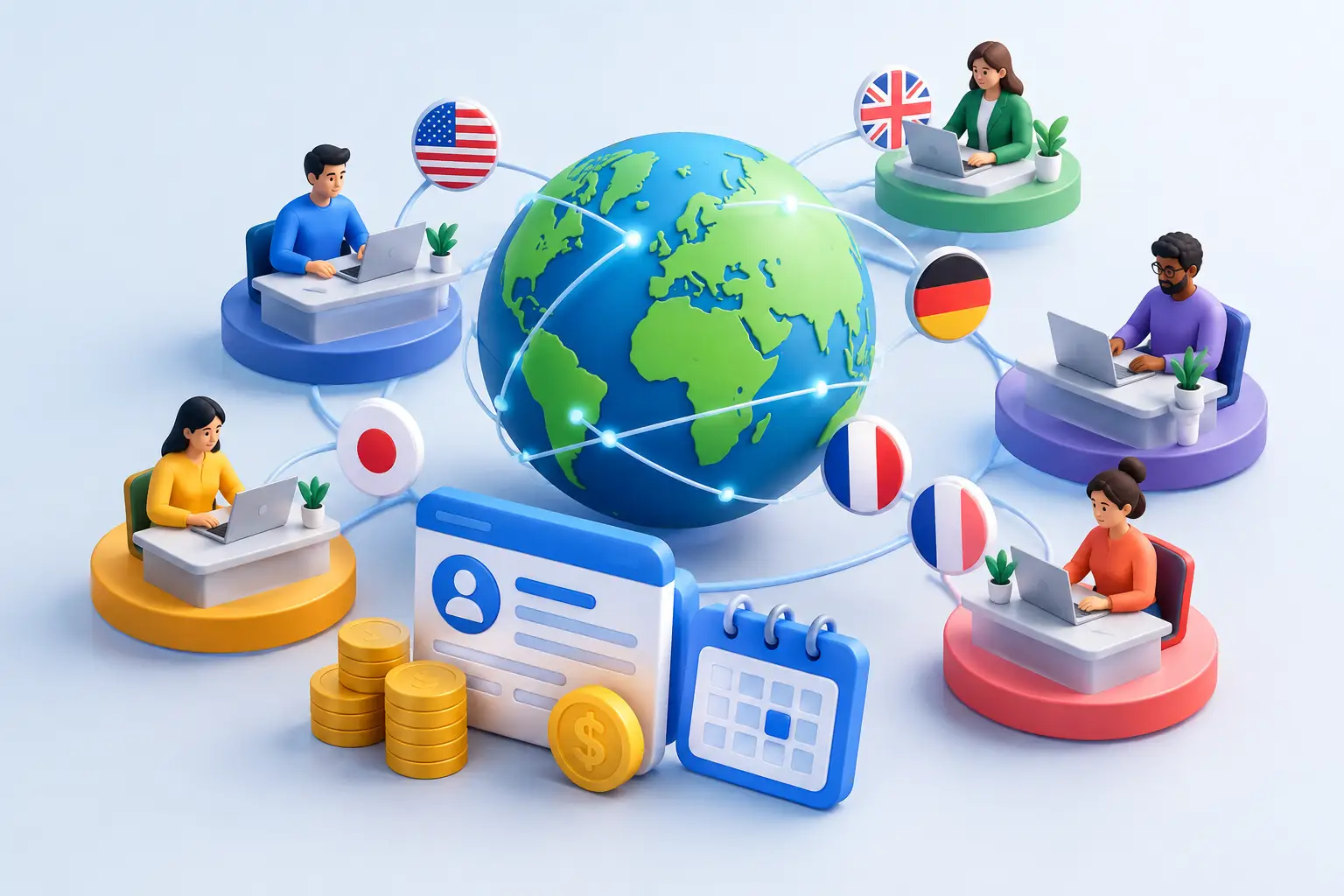
A Singapore employee receives a payslip with CPF contributions and locally required earnings treatment. A New Zealand employee may require PAYE calculations, KiwiSaver handling, and a bank file in the format local institutions accept. The employee record may sit in one global system, but the rules behind each pay run cannot be globalized by simply changing the currency. That is what payroll localization addresses.
What Is Payroll Localization?
Payroll localization is the configuration and ongoing maintenance of payroll processes so they comply with the tax, social insurance, employment, reporting, payment, and recordkeeping requirements of a specific country or jurisdiction.
In practical terms, localized payroll turns a global pay policy into a locally correct gross-to-net calculation. It applies the right statutory deductions, employer contributions, leave treatment, overtime rules, payslip fields, filing outputs, and payment formats for the location where a person is employed.
Localization is not just translation, currency conversion, or a library of tax rates. A payroll platform can display English-language screens and pay employees in local currency while still producing incorrect results if it does not understand the underlying jurisdictional rules. The local operating model matters: how earnings are classified, when payroll closes, which government agencies receive filings, what evidence must be retained, and how changes are approved.
For organizations expanding across APAC, payroll localization is the control layer that keeps a shared workforce system usable across different legal environments.
Why Local Rules Change the Payroll Design
Payroll is often treated as a finance output. In reality, it is the point where HR data, workforce operations, compensation policy, and local law meet. A change in any one of those inputs can affect the final pay result.
Consider a standard global allowance. One country may treat it as taxable cash compensation, another may apply a different contribution basis, and a third may require it to appear separately on a payslip. Similarly, overtime cannot be calculated reliably if a payroll engine receives only a monthly salary figure. It needs approved time, schedules, attendance exceptions, public-holiday treatment, and the local rule set that determines eligibility and rates.
This is why payroll localization has both calculation and workflow dimensions. The system must calculate correctly, but it must also route changes through the right approvals, preserve an audit trail, and produce country-appropriate documentation. A retroactive salary adjustment, for example, may need to recalculate prior periods differently from a current-period change.
The details vary by jurisdiction, but localization commonly covers four connected areas:
- Statutory calculations, including income tax withholding, employee deductions, employer contributions, levy obligations, and contribution caps.
- Employment and pay rules, including minimum pay requirements, overtime, leave payments, termination treatment, and earnings classifications.
- Compliance outputs, including payroll registers, payslips, statutory filings, year-end reporting, and retention requirements.
- Payment operations, including local bank-file formats, payment references, pay calendars, and reconciliation data.
A payroll process is localized only when these elements work together in the context of the country. Having a spreadsheet for tax rates and a separate manual bank upload is not the same as a localized payroll operating model.
Payroll Localization vs. Global Payroll Standardization
Global standardization is still valuable. Organizations should standardize employee data definitions, approval controls, pay-cycle governance, chart-of-accounts mappings, reporting metrics, and integration patterns wherever possible. The mistake is assuming standardization means identical country processes.
The stronger model is global consistency with local execution. A company might use one job architecture, one compensation approval workflow, one identity layer, and one reporting model across every entity. Country packs then apply local statutory logic and outputs without forcing HR, finance, and payroll teams to rebuild the process country by country.
This distinction matters during audits and month-end close. Finance wants comparable labor-cost reporting across entities. Payroll needs the flexibility to meet local filing requirements. IT needs role-based access control, SSO, APIs, and data governance that do not fragment as new markets are added. A composable platform can support all three when its country-level rules operate on the same employee and organizational data model.
What Effective Payroll Localization Looks Like
Effective localization starts with clean source data. The payroll engine needs a reliable legal employer, work location, tax profile, compensation package, bank details, employment status, and effective date for every worker. If these inputs are distributed across HR software, time systems, recruiting tools, and spreadsheets, payroll teams spend each cycle reconciling information before they can validate pay.
The next requirement is rules that are designed for change. Tax thresholds, contribution rates, filing schemas, and statutory guidance evolve. A static implementation can be correct at go-live and gradually become a risk as local requirements shift. Country packs should therefore be versioned, maintained, tested, and applied with clear effective dates.
Operational controls are equally important. Payroll teams need variance reports that flag unusual net pay, contribution changes, missing bank details, duplicate payments, and unexpected retroactivity before finalization. They also need segregation of duties: the person who changes a tax-sensitive employee field should not necessarily be the person who approves the pay run or releases a payment file.
A mature localized payroll environment retains the evidence behind each result. That includes source changes, calculation details, approvals, exports, filings, and payment status. For HR and finance, this reduces time spent answering routine questions. For compliance and IT, it establishes a defensible audit trail.
Country Packs Are More Than Tax Tables
A country pack is the operational expression of payroll localization inside a platform. It typically contains jurisdiction-specific calculation logic, statutory settings, reporting templates, and payment outputs. The best country packs are not isolated add-ons. They use the same core employee record, workflow engine, permissions model, and analytics layer as the rest of the HCM system.
That architecture changes how payroll scales. When an employee receives a promotion, changes location, or moves between legal entities, the update can flow through governed lifecycle workflows rather than being rekeyed into separate payroll tools. When a manager approves overtime, the approved time data can feed the relevant calculation rules. When payroll is finalized, finance can receive controlled journal data without rebuilding mappings each period.
For example, a platform supporting Singapore and New Zealand should accommodate the distinct statutory logic and native bank-file expectations of each market while preserving centralized reporting. As coverage expands to Hong Kong, Australia, and additional jurisdictions, the organization should not need a different employee database or a new access-control model for every country.
This is the difference between buying local capability and building a multi-country operating foundation.
Common Failure Modes in Localized Payroll
The most common failure is overreliance on manual expertise. Local payroll specialists are essential, but a process that depends on one person remembering exceptions, updating a private spreadsheet, and uploading files manually does not scale well. It creates key-person risk and makes controls difficult to prove.
Another failure is treating payroll as downstream from HR. If the payroll team receives late or incomplete changes to salary, leave, time, legal entity, or bank details, the calculation engine has no opportunity to prevent avoidable corrections. Payroll localization works best when the upstream workforce processes are connected and effective-dated.
A third issue is using a single global payroll template that lacks local depth. This may appear efficient initially, especially for small headcounts. The trade-off arrives when statutory requirements, year-end reporting, or payment operations demand exceptions that the template cannot represent. Teams then compensate with offline workarounds, which erode data quality and increase reconciliation effort.
Finally, automation without governance can create its own risk. AI can accelerate payroll queries, identify anomalies, and prepare workflows, but it should not make untraceable changes to tax-sensitive data. Governed AI agents need source citations, role-based permissions, regional data controls, and audit logs. AI-native payroll operations should improve accountability, not obscure it.
How to Assess Your Payroll Localization Readiness
Start with a country-by-country view of your workforce. Identify the legal entities, worker types, pay frequencies, time policies, benefit plans, statutory filings, payment methods, and data-residency obligations in each location. This exposes whether your operating complexity comes from geography, workforce design, or disconnected systems.
Then assess the handoffs. Can payroll consume approved employee, compensation, leave, and time data directly from a single source of truth? Can finance trace payroll results to journals and payments? Can IT determine who changed a field, when it changed, and which downstream calculation it affected? If the answer is no, adding a new country may multiply manual work rather than extend a repeatable model.
It is also worth separating genuine localization requirements from internal preferences. Some differences are statutory and non-negotiable. Others reflect legacy processes that could be standardized across entities. This distinction helps teams preserve local compliance while reducing unnecessary variation.
ZingKey is built around this model: one composable system with shared workforce data and country-specific payroll capability, rather than disconnected HR and payroll applications that must be reconciled every cycle.
A Better Way to Plan Market Expansion
Do not wait until the first payroll deadline in a new country to define the local model. Treat payroll localization as an entry requirement alongside entity setup, banking, employment contracts, benefits, and workforce policy. Confirm what data is required, what statutory outputs are due, who owns approvals, and how results will enter finance systems before the first employee is onboarded.
The goal is not to make every market look identical. It is to give each market the local precision it requires while allowing the company to operate from one controlled workforce foundation. When the next expansion decision arrives, payroll should be a planned system capability, not a last-minute reconciliation project.